OFFICE FOR MEN — FULL DEPARTMENTAL MODELLING
Australians Unified Format — Consistent with all other sub‑department models
WHAT THE OFFICE FOR MEN WOULD DO
Portfolio: Attorney‑General’s Portfolio (recommended for independence) Agency: Office for Men (OfM)
Purpose: To improve men’s wellbeing, strengthen families, reduce violence through early intervention, and support men’s health, mental health, economic security and positive community participation.
Core responsibilities:
-
National men’s wellbeing and mental health strategy
-
Early‑intervention programs to reduce family violence
-
Support for fathers, parenting and healthy relationships
-
Workforce participation and economic security initiatives
-
Suicide prevention and mental health access
-
Education on respectful relationships and emotional literacy
-
Support for men in regional, rural and remote communities
-
Data, research and national reporting on men’s wellbeing
Who OfM serves:
-
Men and boys across Australia
-
Fathers, families and caregivers
-
Community organisations and frontline services
-
Employers, educators and health providers
-
Government agencies and policymakers
GENERAL OPERATIONS (CURRENT NEED)
Because this agency does not currently exist, its operational model is built from identified gaps:
-
Limited national coordination on men’s wellbeing
-
Fragmented mental health and early‑intervention programs
-
Insufficient support for fathers and parenting
-
Limited services for men in crisis
-
Inconsistent education on emotional wellbeing
-
High rates of male suicide, especially in regional areas
-
Limited culturally safe services for First Nations men
-
Lack of national data on men’s wellbeing and risk factors
Operational characteristics:
-
High‑engagement, community‑centred
-
Strong cross‑government coordination
-
Heavy reliance on mental health, social services and education systems
-
WHY THIS AGENCY IS NEEDED
Key challenges:
-
Men are over‑represented in suicide, homelessness and substance misuse
-
Many men lack access to early support before crisis
-
Family violence prevention often focuses on response, not root causes
-
Boys and young men face social isolation and identity pressures
-
Fathers often lack support during separation, custody and parenting
-
Regional men face higher health and mental health risks
-
Limited culturally safe services for First Nations men
If unchanged:
-
Higher rates of family violence
-
Increased mental health crises
-
Intergenerational trauma
-
Poorer outcomes for children
-
Higher long‑term social and economic costs

STRENGTHS
-
Addresses major national wellbeing gaps
-
Strong preventative focus
-
Supports families and reduces long‑term harm
-
High potential for cross‑government impact
-
Strong alignment with mental health and justice reforms
- lower suicide rate

WEAKNESSES
-
New agency requiring cultural change
-
Potential public misunderstanding of purpose
-
Requires strong coordination with existing services
-
Limited baseline data on men’s wellbeing

THREATS
-
Stigma around men seeking help
-
Under‑resourced community services
-
Regional service gaps
-
Economic pressures increasing stress and risk factors
OPPORTUNITIES
-
Reduce family violence through early intervention
-
Improve men’s mental health and wellbeing
-
Strengthen families and parenting outcomes
-
Support boys and young men in education
-
Improve workforce participation and economic security
-
Build culturally safe programs for First Nations men
FUTURE MODEL (PREVENTION‑LED, DATA‑DRIVEN, FAMILY‑STRENGTHENING)
A. National Men’s Wellbeing & Mental Health System
-
Early‑intervention counselling
-
Crisis support pathways
-
Digital mental health tools
-
Regional men’s wellbeing hubs
B. Family Violence Prevention Through Early Support
-
Programs for emotional regulation, communication and conflict resolution
-
Support for men experiencing stress, unemployment or relationship breakdown
-
Culturally safe programs for First Nations men
-
Community‑led mentoring and role‑modelling
C. Fathers, Parenting & Family Support
-
National fatherhood programs
-
Co‑parenting support
-
Parenting education
-
Support for separated fathers
D. Economic Security & Workforce Participation
-
Skills and employment pathways
-
Support for men in declining industries
-
Programs for young men disengaged from education
E. Education & Youth Development
-
Emotional literacy in schools
-
Healthy masculinity programs
-
Mentoring and leadership pathways
-
Support for boys at risk of disengagement
F. National Men’s Wellbeing Data Network
-
Real‑time wellbeing indicators
-
Predictive modelling for risk factors
-
Public reporting dashboards
- National approach for mens support groups

COSTING MODEL (PHASED)
BASELINE FUNDING (NEW AGENCY)
$0.25B per year (Aligned with Office for Women baseline)
PHASE 1 — YEARS 1–2
$0.18B – $0.25B
-
Establish agency
-
Build national wellbeing framework
-
Launch early‑intervention pilots
-
Create national data architecture
PHASE 2 — YEARS 2–4
$0.50B – $0.70B
-
National men’s wellbeing hubs
-
Fatherhood and parenting programs
-
Youth emotional literacy programs
-
Regional and remote service expansion
PHASE 3 — YEARS 4–6
$0.35B – $0.50B
-
National wellbeing intelligence network
-
Predictive modelling
-
Public dashboards
-
Workforce participation programs
PHASE 4 — YEARS 6–10
$0.80B – $1.10B
-
Fully integrated national wellbeing ecosystem
-
Automated reporting
-
Continuous improvement
STRATEGIC ROADMAP
PHASE 1 — FOUNDATION (Years 1–2)
-
Establish agency
-
Build national wellbeing framework
-
Launch early‑intervention pilots
-
Create national data architecture
PHASE 2 — ACCELERATION (Years 2–4)
-
National men’s wellbeing hubs
-
Parenting and fatherhood programs
-
Youth emotional literacy initiatives
-
Regional service expansion
PHASE 3 — EXPANSION (Years 4–6)
-
National wellbeing intelligence network
-
Real‑time dashboards
-
Workforce participation programs
PHASE 4 — FUTURE‑READY (Years 6–10)
-
Fully integrated wellbeing ecosystem
-
Predictive modelling
-
Continuous improvement
STEP 8 — PORTFOLIO HIGHLIGHTS (PUBLIC‑FACING)
-
National leadership in men’s wellbeing and mental health
-
Early‑intervention programs reducing family violence
-
Support for fathers, parenting and healthy relationships
-
Emotional literacy and youth development programs
-
Regional and remote men’s wellbeing hubs
-
Culturally safe programs for First Nations men
-
National wellbeing data and transparency
-
Stronger families, safer communities, healthier men
EQUAL RIGHTS FOR FATHERS IN PARENTING & COURT PROCEEDINGS
Australians Unified — Office for Men
⭐ Why This Reform Matters
Fathers deserve fair, consistent, and transparent treatment in parenting arrangements and family court processes. Children deserve strong relationships with both parents wherever it is safe to do so.
This reform strengthens families, reduces conflict, and improves long‑term outcomes for children — fully aligned with the Office for Men’s purpose and wellbeing model .
🟦 1. Equal Parenting Rights as the Starting Point
A national framework where:
-
Both parents begin with equal standing
-
Shared care is the default starting position (unless risk is identified)
-
Parenting time is based on child wellbeing, stability, and parental capacity
-
Decisions are evidence‑based, not assumption‑based
This aligns with your broader reform agenda for fairness, transparency, and child‑centred outcomes.
🟩 2. Fair, Fast, Transparent Court Processes
Reforms to ensure fathers are treated fairly in the family law system:
-
Clear, consistent decision rules
-
Standardised national parenting order templates
-
Faster dispute resolution
-
Early‑intervention mediation
-
Reduced legal costs
-
Transparent reasoning for all decisions
This directly addresses the “limited support for fathers” and “fragmented systems” identified on your page .
🟫 3. Support for Fathers During Separation
A national support system for fathers navigating separation:
-
Co‑parenting education
-
Mental health and emotional support
-
Early‑intervention counselling
-
Parenting skills programs
-
Support for fathers in crisis
-
Services for regional and remote fathers
This matches the Office for Men’s wellbeing, mental health, and early‑intervention model .
🟡 4. Protecting Children Through Better Risk Assessment
A modern, consistent, evidence‑based risk framework:
-
Clear definitions of risk
-
Nationally consistent assessment tools
-
Cultural safety for First Nations families
-
Early support for families under stress
-
Focus on prevention, not punishment
This aligns with your prevention‑led, data‑driven future model for the Office for Men .
🔴 5. National Fatherhood & Parenting Programs
Programs designed to strengthen father‑child relationships:
-
National Fatherhood Program
-
Healthy relationships and communication skills
-
Parenting education
-
Support for young fathers
-
Community‑led mentoring
-
Digital tools for separated dads
These programs are already part of your Office for Men future model (Section C: Fathers, Parenting & Family Support) .
⚖️ 6. Legal and Policy Reforms for Fairness
Working with the Attorney‑General’s Department to:
-
Modernise family law
-
Improve access to justice
-
Ensure equal procedural rights
-
Strengthen accountability and transparency
-
Reduce delays and inconsistent outcomes
This aligns with the Office for Men’s cross‑government coordination role and AGD’s justice responsibilities.
🌏 7. Outcomes for Children, Fathers & Families
This reform delivers:
-
Stronger father‑child relationships
-
Reduced conflict
-
Better mental health for fathers
-
More stable parenting arrangements
-
Safer, healthier families
-
Long‑term social and economic benefits
All consistent with the wellbeing, prevention, and family‑strengthening goals on your page .

🔵 SUPPORT STRUCTURES FOR SINGLE‑PARENTING FATHERS
Australians Unified — Office for Men
Single fathers deserve strong, reliable support — emotionally, financially, socially, and legally. This reform builds a national support system that strengthens families and improves outcomes for children.
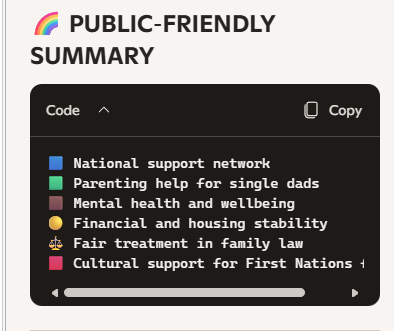
🟦 1. National Single Fathers Support Network
A coordinated, nationwide system providing:
-
Local support hubs
-
Online and phone support
-
Peer‑to‑peer mentoring
-
Community‑led fatherhood groups
-
Regional and remote outreach
🟩 2. Practical Parenting Support
Helping single dads manage day‑to‑day responsibilities:
-
Parenting skills programs
-
Child development and behaviour support
-
Co‑parenting guidance
-
Access to early‑intervention services
-
School and childcare navigation
🟫 3. Mental Health & Emotional Wellbeing
A dedicated wellbeing pathway for single fathers:
-
Free counselling sessions
-
Trauma‑informed support
-
Men’s mental health specialists
-
Crisis support for fathers under stress
-
Digital wellbeing tools
🟡 4. Financial & Housing Stability Support
Reducing the pressure on single dads raising children alone:
-
Help accessing payments and entitlements
-
Housing assistance and stability programs
-
Employment and training pathways
-
Budgeting and financial coaching
⚖️ 5. Fair Treatment in Family Law & Child Support
Ensuring single fathers are treated fairly and consistently:
-
Clear, transparent court processes
-
Equal rights in parenting decisions
-
National parenting order templates
-
Fair child‑support assessments
-
Early‑intervention dispute resolution
🟥 6. Community & Cultural Support for First Nations Fathers
Culturally safe support for Aboriginal and Torres Strait Islander dads:
-
On‑Country fatherhood programs
-
Elders‑led mentoring
-
Community‑controlled service pathways
-
Support for young fathers
-
Integration with regional governance hubs