Department of the Treasury
Treasury is the Government’s principal economic adviser, providing critical insights and guidance. We are dedicated to delivering comprehensive advice to the Government and implementing a wide range of policies and programs aimed at achieving strong, sustainable economic and fiscal outcomes for all Australians. Our team diligently anticipates and thoroughly analyses policy issues with a holistic, whole-of-economy perspective. We take the time to understand the complexities of government and stakeholder circumstances, enabling us to respond rapidly and effectively to changing events and emerging directions in the economic landscape.

TREASURY PORTFOLIO
Full Departmental Modelling — Australians Unified Format
STEP 1 — WHAT THE TREASURY PORTFOLIO DOES NOW
Portfolio: Treasury Agencies (recommended structure):
-
Department of the Treasury
-
Australian Taxation Office (ATO)
-
Australian Bureau of Statistics (ABS)
-
Productivity Commission
-
Foreign Investment Review Board (FIRB)
-
Australian Competition & Consumer Commission (ACCC)
-
Australian Prudential Regulation Authority (APRA)
-
Australian Securities & Investments Commission (ASIC)
Current responsibilities:
-
National economic policy and forecasting
-
Budget strategy and fiscal policy
-
Taxation policy and revenue systems
-
Competition, consumer and market regulation
-
Foreign investment oversight
-
Financial system stability and prudential regulation
-
Economic data, modelling and national statistics
-
Productivity, innovation and long‑term economic planning
Who Treasury serves:
-
Government and Parliament
-
Businesses, investors and industry
-
Households and workers
-
Financial institutions
-
State, territory and local governments
-
International partners and economic bodies
GENERAL OPERATIONS (CURRENT)
-
Develops national economic policy
-
Prepares the Federal Budget and fiscal strategy
-
Oversees taxation and revenue systems
-
Regulates markets, competition and consumer protections
-
Monitors financial system stability
-
Conducts economic modelling and forecasting
-
Oversees foreign investment approvals
-
Publishes national statistics and economic indicators
Operational characteristics:
-
High‑analysis, high‑integrity environment
-
Strong cross‑government influence
-
Heavy reliance on data, modelling and forecasting
-
High public visibility and accountability
-
Central role in national economic stability
WHY CHANGE IS NEEDED
Key challenges:
-
Increasing economic volatility and global uncertainty
-
Rising cost‑of‑living pressures
-
Ageing population and workforce shortages
-
Slow productivity growth
-
Fragmented data systems across agencies
-
Legacy modelling tools and manual workflows
-
Need for stronger long‑term economic planning
-
Increasing cyber and financial system risks
If unchanged:
-
Slower economic response to shocks
-
Reduced productivity and competitiveness
-
Higher long‑term fiscal pressures
-
Weaker financial system resilience
-
Reduced public trust in economic institutions

STRENGTHS
-
Strong national mandate
-
Highly skilled economic and analytical workforce
-
Deep institutional knowledge
-
Strong international credibility
-
Comprehensive data and modelling capability

WEAKNESSES
-
Legacy systems and slow modelling cycles
-
Fragmented data across agencies
-
Limited real‑time economic visibility
-
High complexity in tax and regulatory systems
-
Workforce shortages in digital and modelling roles

THREATS
-
Global economic shocks
-
Cybersecurity risks
-
Inflation and cost‑of‑living pressures
-
Ageing population and workforce decline
-
Geopolitical instability
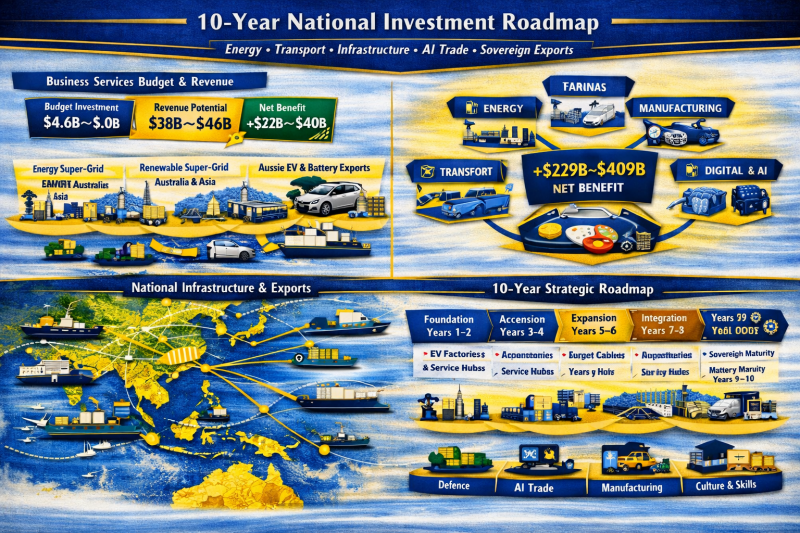
⭐ HERO BANNER — UNIFIED INVESTMENT STRATEGY
Energy • Transport • Infrastructure • AI Trade • Sovereign Exports
🔷 Top Left: Budget & Revenue
-
$4.6B–$6B investment → $38B–$46B revenue
-
Net benefit: $32B–$40B
-
Includes EV exports, battery licensing, hydrogen logistics, AI trade
🔶 Top Right: Cross-Portfolio Investment
-
Energy, Transport, Manufacturing, Digital, Culture, Workforce
-
All converge into a $229B–$409B national return
🟨 Bottom Left: Infrastructure & Exports
-
National Energy Grid
-
Renewable Super-Grid (Australia → Asia)
-
EV factories, service hubs, subsea cables, hydrogen routes
🟩 Bottom Right: Strategic Roadmap
-
Years 1–2: Foundation
-
Years 3–4: Acceleration
-
Years 5–6: Expansion
-
Years 7–8: Indo-Pacific Integration
-
Years 9–10: Sovereign Maturity
🧩 Outcome
Australia builds a sovereign economic engine powered by unified investment, AI governance, and Indo-Pacific export capability.
OPPORTUNITIES
-
AI‑enabled economic forecasting
-
Unified national economic data platform
-
Modernised tax and revenue systems
-
Stronger productivity and innovation agenda
-
Transparent, real‑time economic reporting
FUTURE MODEL (AI‑ENABLED, RESILIENT, LONG‑TERM)
A. National Economic Intelligence Platform
-
Unified economic data architecture
-
Real‑time dashboards for inflation, wages, productivity and markets
-
AI‑enabled forecasting and scenario modelling
-
Integrated Treasury–Finance–ABS modelling environment
B. Modernised Tax & Revenue System
-
Automated compliance and risk detection
-
Real‑time revenue forecasting
-
Simplified tax administration
-
Digital identity and secure payments integration
C. Productivity & Innovation Strategy
-
National productivity roadmap
-
Industry transformation modelling
-
Workforce capability and skills forecasting
-
Innovation, R&D and technology adoption incentives
D. Financial System Stability & Regulation
-
Real‑time prudential monitoring
-
Cyber‑resilience and digital finance oversight
-
AI‑enabled risk modelling for banks and insurers
-
Stronger consumer protections
E. Competition, Markets & Consumer Policy
-
Modernised competition frameworks
-
Digital platform regulation
-
Transparent pricing and market fairness systems
-
National consumer data protections
F. Long‑Term Economic Planning
-
10‑, 20‑ and 30‑year economic outlooks
-
Climate, demographic and technological modelling
-
National resilience and supply chain forecasting

STRATEGIC ROADMAP
PHASE 1 — FOUNDATION (Years 1–2)
-
Build unified economic data architecture
-
Deploy AI forecasting pilots
-
Modernise tax and revenue workflows
-
Launch national dashboards
PHASE 2 — ACCELERATION (Years 2–4)
-
National Economic Intelligence Platform
-
Productivity and innovation strategy
-
Financial system resilience upgrades
-
Modernised competition and consumer frameworks
PHASE 3 — EXPANSION (Years 4–6)
-
Predictive modelling
-
Real‑time economic dashboards
-
Long‑term planning systems
PHASE 4 — FUTURE‑READY (Years 6–10)
-
Fully integrated economic ecosystem
-
Automated reporting
-
Continuous improvement
STEP 8 — PORTFOLIO HIGHLIGHTS (PUBLIC‑FACING)
-
National leadership in economic stability and long‑term planning
-
AI‑enabled forecasting and real‑time economic intelligence
-
Modernised tax and revenue systems
-
Stronger productivity, innovation and workforce planning
-
Transparent economic dashboards for the public
-
Resilient financial system and consumer protections
-
Integrated national economic data ecosystem
-
Better outcomes for households, businesses and the nation
COSTING MODEL (PHASED)
BASELINE FUNDING (REDUCED)
$3.2B per year (Reduced from $4.6B — 30% efficiency gain)
PHASE 1 — YEARS 1–2
$2.2B – $3.2B
-
AI pilots for forecasting and modelling
-
Unified economic data architecture
-
Tax and revenue system automation
-
National economic dashboard pilots
PHASE 2 — YEARS 2–4
$6.0B – $8.0B
-
National Economic Intelligence Platform rollout
-
Modernised tax and compliance systems
-
Productivity and innovation programs
-
Financial system resilience upgrades
PHASE 3 — YEARS 4–6
$4.0B – $6.0B
-
Predictive modelling expansion
-
Public dashboards
-
Long‑term economic planning systems
PHASE 4 — YEARS 6–10
$10.0B – $14.0B
-
Fully integrated national economic ecosystem
-
Automated reporting
-
Continuous improvement
We offer a range of specialized services tailored to meet your individual needs. Our approach is focused on understanding and responding to what you require, providing effective and practical solutions.
