BUSINESS OPERATIONS PORTFOLIO
Delivering the essential services that keep Australia moving.
The Business Operations Portfolio brings together the nation’s core service‑delivery, regulatory and infrastructure agencies into one modern, AI‑enabled department. It is the operational engine room of government — responsible for the systems Australians rely on every day, from transport and communications to postal services, digital identity, regional development, arts, screen, sport and community programs.
By unifying previously fragmented agencies into a single portfolio, we reduce duplication, strengthen national coordination and deliver faster, fairer and more reliable services for every Australian.
Our Mission
To provide a seamless, modern and resilient service‑delivery system that supports communities, businesses and industries across Australia — backed by transparent governance, strong safety standards and world‑class digital infrastructure.
What We Do
The Business Operations Portfolio oversees:
-
Transport & Infrastructure Safe, efficient and reliable aviation, maritime, freight and public transport systems.
-
Communications & Digital Systems National broadband, telecommunications, spectrum, emergency communications and digital identity.
-
Postal & Customer Services Postal delivery, logistics, identity verification and national service centres.
-
Regional Development & Community Investment Stronger regional economies, disaster recovery, local government partnerships and community resilience.
-
Creative Industries & Cultural Development Arts, screen, cultural institutions and creative sector investment.
-
Sport & Integrity National sport programs, high‑performance pathways and integrity frameworks.
-
National Data, Safety & Compliance Real‑time intelligence, safety regulation, licensing, standards and enforcement.
Why This Portfolio Matters
Australia’s essential services were once spread across more than a dozen agencies. This created duplication, inconsistent service standards and slow response times.
The Business Operations Portfolio brings these functions together to:
-
streamline service delivery
-
reduce administrative overhead
-
strengthen national resilience
-
modernise digital systems
-
improve transparency and accountability
-
deliver better outcomes for communities and businesses
This is a portfolio built for a modern Australia — one that is connected, creative, resilient and future‑ready.
Our Commitment to Australians
We are committed to:
-
Reliable services — no matter where you live
-
Stronger regional and remote access
-
Safer transport and communications networks
-
Fair and transparent funding programs
-
Support for Australia’s creative and cultural identity
-
Modern digital systems that protect privacy and security
-
Efficient, customer‑centred service delivery
A Modern, Unified Approach
By integrating transport, communications, postal services, regional development, arts, screen, sport and business‑facing programs, the Business Operations Portfolio delivers:
-
one operational strategy
-
one digital backbone
-
one customer experience
-
one national standard
This unified approach ensures that government services are easier to access, more consistent and more responsive to the needs of Australians.

Corporate & Governance Division — Portfolio Highlights
-
Unified corporate services supporting all divisions across the portfolio.
-
Modern, secure ICT, finance, HR, procurement and governance systems.
-
Stronger cybersecurity and risk management protecting national operations.
-
AI‑enabled data, forecasting and performance dashboards for real‑time decision‑making.
-
Streamlined governance frameworks improving transparency and accountability.
-
Shared digital platforms reducing duplication and operational costs.
-
Faster, more consistent reporting across all service‑delivery areas.
-
Stronger workforce capability through unified training and development systems.
-
Integrated legal, audit and compliance functions supporting national standards.
-
Lower administrative overhead through whole‑of‑portfolio consolidation.

6. Sport & Integrity Division — Portfolio Highlights
-
Unified national leadership across sport, integrity and high‑performance pathways.
-
Stronger integrity frameworks protecting athletes, competitions and communities.
-
Fair, transparent funding for community sport and high‑performance programs.
-
AI‑enabled performance, wellbeing and participation monitoring.
-
Modernised systems supporting athlete development and national sporting success.
-
Streamlined governance replacing fragmented sport programs across agencies.
-
Stronger partnerships with national sporting organisations and state bodies.
-
Improved access to sport for regional, remote and under‑represented communities.
-
Enhanced safety standards across all levels of sport.
-
Lower costs through unified sport administration and shared digital systems.

2. Communications & Digital Systems Division — Portfolio Highlights
-
National leadership across broadband, telecommunications, spectrum and digital identity.
-
24/7 monitoring of Australia’s digital and communications networks.
-
Stronger cyber‑resilience and digital safety protections for households and businesses.
-
AI‑enabled network forecasting to improve reliability, performance and emergency readiness.
-
Modern digital identity and access systems supporting secure public services.
-
Integrated emergency communications for faster, more coordinated national responses.
-
Streamlined regulation of carriers, broadcasters and digital platforms.
-
Improved regional and remote connectivity through unified digital infrastructure planning.
-
Transparent, consistent national standards for digital safety and online protections.
-
Lower costs through shared platforms, shared data and consolidated ICT systems.

1. National Infrastructure & Transport Division — Portfolio Highlights
-
Unified national leadership across aviation, maritime, freight, logistics and land transport.
-
24/7 operational oversight of air traffic control, maritime safety and national transport networks.
-
Stronger national safety standards through integrated regulation and compliance.
-
Real‑time transport intelligence using AI‑enabled forecasting and performance monitoring.
-
Modern, resilient infrastructure supporting airports, ports, freight corridors and public transport.
-
Faster national response to disruptions, emergencies and supply‑chain shocks.
-
Streamlined regulatory frameworks replacing fragmented state and territory rules.
-
Improved freight efficiency through coordinated logistics and multimodal planning.
-
Better connectivity for regional and remote communities.
-
Reduced duplication and lower costs through unified systems and governance.

2. Communications & Digital Systems Division — Portfolio Highlights
-
National leadership across broadband, telecommunications, spectrum and digital identity.
-
24/7 monitoring of Australia’s digital and communications networks.
-
Stronger cyber‑resilience and digital safety protections for households and businesses.
-
AI‑enabled network forecasting to improve reliability, performance and emergency readiness.
-
Modern digital identity and access systems supporting secure public services.
-
Integrated emergency communications for faster, more coordinated national responses.
-
Streamlined regulation of carriers, broadcasters and digital platforms.
-
Improved regional and remote connectivity through unified digital infrastructure planning.
-
Transparent, consistent national standards for digital safety and online protections.
-
Lower costs through shared platforms, shared data and consolidated ICT systems.

5. Creative Industries & Cultural Development Division — Portfolio Highlights
-
Unified national leadership across arts, screen, culture and creative industries.
-
Fair, transparent funding for creators, organisations and cultural institutions.
-
Stronger support for First Nations storytelling and cultural preservation.
-
AI‑enabled cultural intelligence tracking participation, trends and workforce needs.
-
Modern digital tools for creators, producers and cultural organisations.
-
Streamlined grants, reporting and compliance systems across the creative sector.
-
Stronger international partnerships and global visibility for Australian content.
-
Improved access for regional and emerging creators.
-
Integrated cultural policy supporting national identity and creative innovation.
-
Lower administrative costs through consolidated funding and governance systems.

4. Regional Development & Community Investment Division — Portfolio Highlights
-
Stronger regional economies through unified development, investment and community programs.
-
Faster, more coordinated disaster recovery and resilience support.
-
Integrated partnerships with councils, communities and local industries.
-
AI‑enabled regional intelligence tracking population, workforce and economic trends.
-
Fair, transparent regional grants and infrastructure funding.
-
Improved access to services for rural and remote communities.
-
Streamlined governance replacing fragmented regional programs across agencies.
-
Stronger local government capability through shared systems and national standards.
-
Better planning for housing, transport, digital access and community wellbeing.
-
Lower costs through unified regional operations and shared service delivery.
Beyond the ordinary
LEADERSHIP MODEL
Minister for Business Operations
Leads the entire operational portfolio.
Secretary of the Business Operations Portfolio
Chief executive of the department.
Deputy Secretaries (One per Division)
-
Infrastructure & Transport
-
Communications & Digital Systems
-
Postal & Customer Services
-
Regional Development
-
Creative Industries
-
Sport & Integrity
-
Corporate & Governance
Chief Data & Intelligence Officer
Oversees national modelling, forecasting and dashboards.
Chief Cyber & Digital Security Officer
Protects national digital infrastructure.
Chief Operating Officer
Runs day‑to‑day operations.

COST SAVINGS (DETAILED)
A. Corporate Services Consolidation
-
HR, finance, ICT, procurement, legal Savings: $1.2B per year
B. ICT & Digital Systems Consolidation
-
One grants system
-
One identity system
-
One customer service platform
-
One data & intelligence network Savings: $1.8B per year
C. Infrastructure & Operations Consolidation
-
Shared logistics
-
Shared service centres
-
Shared digital infrastructure Savings: $1.1B per year
D. Reduction in Duplication Across Agencies
-
Policy
-
Reporting
-
Governance
-
Communications Savings: $0.9B per year
⭐ TOTAL ANNUAL SAVINGS: $5.0B – $5.5B
STRATEGIC ROADMAP
PHASE 1 — Foundation (Years 1–2)
-
Merge overlapping agencies
-
Build unified data architecture
-
Deploy workflow automation
-
Establish Business Operations governance board
PHASE 2 — Acceleration (Years 2–4)
-
AI‑enabled modelling and forecasting
-
Automated grants, reporting and compliance
-
Unified customer service platform
-
National operations dashboards
PHASE 3 — Expansion (Years 4–6)
-
National intelligence networks
-
Workforce augmentation tools
-
Expanded digital infrastructure
-
Transparency and audit upgrades
PHASE 4 — Future‑Ready (Years 6–10)
-
Fully automated service‑delivery cycles
-
Predictive national risk and performance modelling
-
Integrated national operations ecosystem
-
Continuous optimisation
National Resources → Green Robotics → Export Powerhouse
1. Solid‑State Batteries (Core Sovereign Industry)
-
Use Australian lithium + rare earths for domestic battery production
-
Power national EV, defence systems, robotics, and grid storage
-
Export battery packs, modules, and licensed chemistry
2. National Australian Car (Zero‑Emission, Robotic‑Built)
-
Build a sovereign EV platform using green steel + solid‑state batteries
-
Replace government fleets and support regional transport
-
Export EV models, modular platforms, and assembly kits
3. Green Robotic Factories (Powered by Renewables)
-
Manufacture EVs, batteries, robotics, and automation components
-
Use solar, wind, and hydrogen for zero‑emission production
-
Export turnkey “factory‑in‑a‑box” systems and robotics‑as‑a‑service
4. National Resources (Balanced, Non‑Biased Use)
Domestic
-
Lithium → solid‑state batteries
-
Iron ore → green steel for EV frames
-
Aluminium → lightweight EV bodies
-
Rare earths → motors, sensors, robotics
-
Hydrogen → factory power + heavy transport
Export
-
Finished EVs
-
Battery packs
-
Robotic systems
-
Green steel & aluminium
-
Smart factory kits
5. Strategy Principles
-
Value‑add before export
-
Build sovereign capability first
-
Use clean energy for all manufacturing
-
Recycle batteries and metals
-
Create regional manufacturing hubs
Australians Unified — 10‑Year Strategic Infrastructure & Operations Analysis
🧩 1. Business Operations Merge Map
Goal: Consolidate back‑office functions across government portfolios
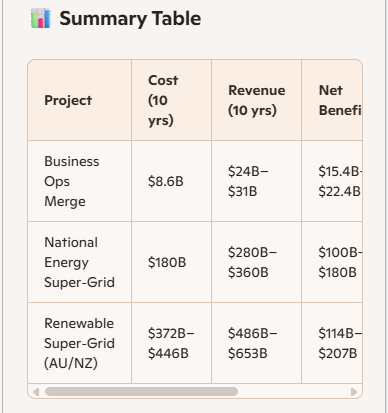
Cost
-
Merge implementation: $4.2B
-
Digital systems integration: $2.8B
-
Staff transition & retraining: $1.6B
-
Total: $8.6B over 10 years
Revenue / Savings
-
Annual savings: $2.4B–$3.1B
-
Net 10‑year savings: $24B–$31B
-
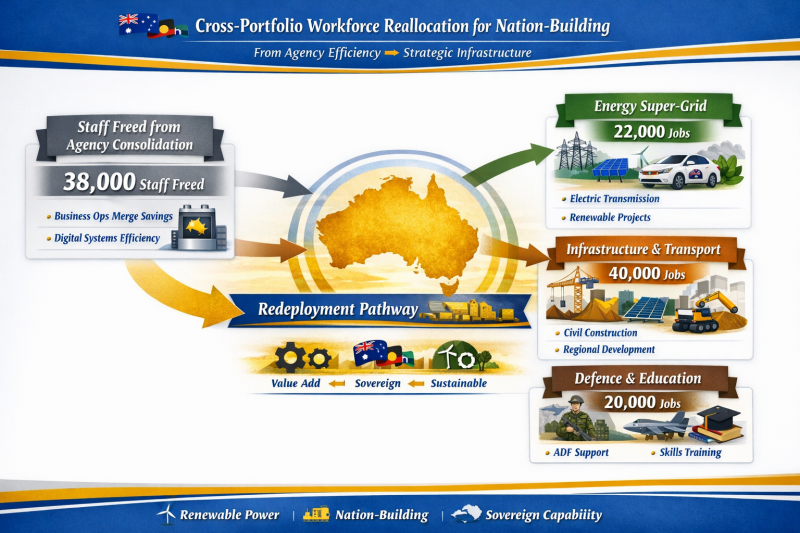
Staff freed: ~38,000 (redeployable to infrastructure, energy, defence, education)
⚡ 2. National Energy Super‑Grid
Goal: Build a unified, renewable‑ready national transmission backbone
Cost
-
Civilian‑only build: $220B
-
Civilian + ADF build: $180B (saves $40B)
-
Preferred model: Civilian + ADF = $180B
Revenue
-
Annual export + domestic benefit: $28B–$36B
-
Net 10‑year benefit: $280B–$360B
-
Payback window: 6–8 years
-
Staff required: ~22,000 (construction, maintenance, operations)
☀️ 3. Renewable Super‑Grid Concept (Australia + NZ + Pacific)
Goal: Expand Australia’s energy spine into Asia and the Pacific
Cost
-
Total investment: $372B–$446B
-
Australia: $290B–$350B
-
NZ: $74B–$84B
-
Pacific: $8B–$12B
-
Revenue
-
Annual revenue: $48.6B–$65.3B
-
Net annual benefit: $30.8B–$51.6B
-
Payback: 7–15 years
-
Staff required: ~60,000 (civilian + ADF + NZDF)
🔄 4. Staff Reallocation Potential
Freed from Business Operations Merge: ~38,000 Needed for Infrastructure Build: ~82,000 Gap: ~44,000 (can be filled via Defence, Education, and regional workforce programs)
✅ Strategic Outcome
-
Total Net Benefit: $229B–$409B
-
Total Staff Freed: 38,000
-
Total Staff Needed: 82,000
-
Gap filled via Defence, Education, regional training

Australians Unified — 10‑Year Sovereign Manufacturing Plan
Green Robotics • National EV • Solid-State Batteries • Export Capability

Budget Allocation (10-Year Total: $28.4B)
Funded via Future Made in Australia Act, sovereign capability grants, and portfolio reallocations.
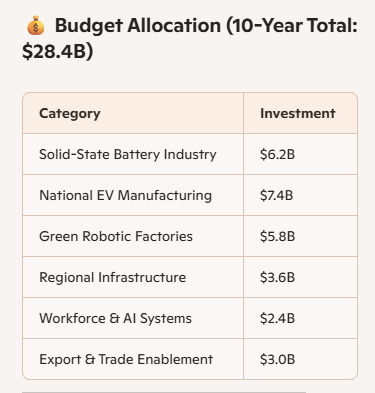
Funded via Future Made in Australia Act, sovereign capability grants, and portfolio reallocations.
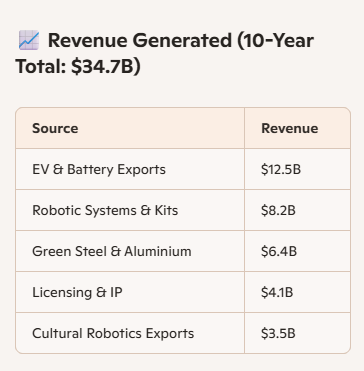
📈 Revenue Generated (10-Year Total: $34.7B)
⚖️ Net Outcome
-
Net Gain: $6.3B surplus over 10 years
-
Jobs Created: 42,000+ across regional and urban hubs
-
Strategic Impact: Sovereign capability, export leadership, cultural renewal