Australian federal prosperity
Australian Federal Prosperity is Australians Unified’s vision for a strong, fair and productive national economy. It explores the federal responsibilities that shape everyday opportunity: sound economic management, transparent taxation and spending, secure jobs, capable businesses and mutually beneficial trade. This page provides plain-language information to help Australians understand the conversation and take part in building common ground.
Frequently asked questions
Find clear answers to common questions about prosperity, the role of the Australian Federal Government and the principles Australians Unified supports. These answers are for general information and community discussion; they are not personal financial, tax, legal or investment advice.

What Prosperity reforms does Australians Unified support?
Australians Unified supports policies that strengthen national productivity, improve economic resilience, encourage innovation, support workforce participation, and create sustainable long-term growth opportunities for Australians.

How could tax systems be improved?
Tax systems can be improved through simplification, transparency, efficiency, and better alignment between revenue collection and public service delivery. The objective is to support economic activity while maintaining essential government services.

How can Australia strengthen domestic industry?
Australia can strengthen domestic industry by investing in advanced manufacturing, critical industries, infrastructure, research, skills development, and regional economic opportunities.
Join the conversation on prosperity
A prosperous Australia is built through informed participation, constructive discussion and shared purpose. Join Australians Unified to explore the Prosperity Portfolio, support our work and connect around practical ideas for Australia’s economic future.
Help shape a more prosperous Australia
Explore Australians Unified, join the conversation and connect with people working towards practical, accountable and inclusive prosperity across every State and community.
Road and Rail Network on the Supergrid
The integration of a robust road and rail network within the supergrid is essential for enhancing transportation efficiency and connectivity across Australia. This supergrid is not just about electricity; it also signifies a harmonious blend of various transport systems designed to facilitate seamless movement of goods and people. The road infrastructure provides flexibility for short-distance travel and access to remote areas, while the rail system offers a reliable, efficient means of transporting larger quantities over longer distances. By aligning the development of these transport networks with the supergrid framework, we can ensure reduced congestion, lower emissions, and better overall access to services and markets. This integrated approach supports economic growth, improves regional development, and promotes sustainability across the nation.
Understanding Australia's Connection Points and Their Role in National Systems
Australia is a vast continent with diverse landscapes, cultures, and systems that connect its regions and people. At the heart of these connections are key infrastructure points that facilitate movement, communication, and commerce. Major cities including Sydney, Melbourne, Brisbane, and Perth serve as vital hubs that link various regions. These urban centres are supported by a network of roads, railways, and airports, making transportation integral to connecting communities across different states.
In addition to physical infrastructure, Australia is equipped with advanced digital connectivity. The National Broadband Network (NBN) plays a critical role, providing internet access to urban and remote areas alike. This digital framework not only enhances communication among citizens but also supports businesses, education, and health services, ensuring that even the most isolated communities have access to essential resources.
On a broader scale, these connection points are interlinked with national systems including the economy, governance, and environmental management. The economic activities concentrated in major cities drive growth in regional areas, while policies set by the national government help to balance development between urban and rural communities. Furthermore, sustainable practices are encouraged through systems that connect environmental conservation efforts with economic incentives, promoting a holistic approach to Australia’s development.
Lastly, social systems also thrive on these connections. Community organisations and support networks leverage physical and digital pathways to reach individuals in need, fostering resilience and inclusivity. By understanding and enhancing these connections, Australia can work towards a cohesive approach that nurtures each of its regions while maintaining its unique identity.
In summary, the connection points around Australia are not merely physical locations; they are critical to the functionality of the nation’s systems. By effectively integrating transportation, digital access, economic policies, and social networks, Australia reinforces its commitment to a united and thriving society.
Understanding Water Management: Water Grids and Beyond
Australia's water management system is an intricate network that relies on various components, including water grids, catchments, hydroelectric power, and water distribution. A water grid is a comprehensive infrastructure that connects different water sources, treatment facilities, and supply networks, ensuring a reliable flow of water to urban and rural areas. This grid is vital for balancing water supply and demand, especially during drought conditions, which are common in many parts of Australia.
Catchments are critical to this system, as they are areas where rainfall collects and flows into rivers, lakes, or reservoirs. Healthy catchments are essential for maintaining water quality and quantity, supporting biodiversity, and regulating the water cycle. Protecting these areas from pollution and degradation is paramount to ensure sustainable water resources for future generations.
Furthermore, hydroelectric power plays a significant role in water management by harnessing the energy from flowing water. This renewable energy source not only provides electricity but also aids in the efficient operation of water distribution systems. By integrating hydroelectric generation into water infrastructure, we can support both energy and water needs simultaneously.
Finally, water distribution involves the systems and technology used to deliver water from treatment plants to consumers. Effective distribution systems ensure that communities have access to clean, safe water for drinking, irrigation, and industrial use. Continuous improvements in technology and infrastructure are necessary to enhance efficiency, reduce waste, and adapt to the challenges posed by climate change.
In summary, understanding the interconnectedness of water grids, catchments, hydroelectric power, and water distribution is crucial for developing sustainable water management practices in Australia. Together, these elements contribute to a resilient system that can meet the needs of people and the environment alike.
Clean Energy Supergrid and National Connection
The concept of a clean energy supergrid is becoming increasingly essential as the world seeks to transition towards sustainable energy solutions. This supergrid refers to a vast network that interlinks renewable energy sources, such as solar, wind, and hydropower, allowing for a seamless distribution of clean energy across regions and even countries. In Australia, the vision of a national connection through this supergrid aims to maximise the use of abundant renewable resources while reducing reliance on fossil fuels. By connecting different states and territories, energy can be shared more efficiently, ensuring that regions can benefit from excess energy produced elsewhere, especially during peak generation times.
This interconnected system not only enhances energy security but also stabilises the grid, reducing the chances of blackouts and ensuring a more reliable energy supply for all Australians. Moreover, a clean energy supergrid could significantly lower electricity costs over time by increasing competition among energy providers and enabling the use of the cheapest available renewable sources. The national connection facilitates better management of energy resources, helping to balance supply and demand effectively.
Implementing a clean energy super grid is a tremendous opportunity for Australia to lead in renewable energy innovation. It can also play a crucial role in reducing carbon emissions, helping the nation meet its climate targets and commitment to a sustainable future. Furthermore, such a project could create thousands of jobs in construction, maintenance, and operation, providing a vital economic boost.
In conclusion, the clean energy super grid represents a transformative approach to energy distribution that benefits both the environment and the economy. By investing in a national connection, Australia can harness its renewable energy potential, improve energy resilience, and pave the way for a greener future that supports generations to come.

The Petroleum Industry: Distribution Points and the Importance of Self-Reliance
The petroleum industry plays a crucial role in powering economies and supporting modern lifestyles across Australia and beyond. From extraction to refinement, the journey of petroleum involves numerous distribution points that are vital for ensuring that energy reaches both urban and rural areas efficiently. Understanding these distribution points is essential for grasping how oil and gas products are delivered to the market. Typically, petroleum is extracted from oilfields and transported to refineries through pipelines, tankers, or trucks. Once refined, products like petrol, diesel, and heating oil are distributed through a network of terminals and retail outlets, including service stations. This intricate system highlights not only the importance of the industry but also the need for self-reliance in energy supply.
Self-reliance in the petroleum sector means that a nation or region can meet its own energy needs without excessive dependency on foreign sources. This is vital for several reasons. Firstly, it enhances national security by reducing vulnerability to fluctuating global oil prices and geopolitical tensions. When a country can produce and distribute its own petroleum products, it is less affected by international conflicts or trade disputes. Secondly, self-reliance contributes to economic stability. By investing in local oil extraction and refining facilities, countries can create jobs, foster innovation, and stimulate economic growth. This localized approach not only supports the economy but can also lead to more affordable prices for consumers. Finally, having a self-reliant petroleum industry aids in the transition to alternative energy sources. As nations strive to meet climate goals, a solid foundation in local petroleum resources can help facilitate the shift towards renewable energy solutions while ensuring a steady energy supply during the transition period.
In conclusion, the petroleum industry and its distribution points are not just critical components of our daily lives; they also underscore the importance of self-reliance in ensuring energy security, economic stability, and a sustainable future. By investing in local capabilities, Australia can secure its energy future while continuing to support the global energy market.
Beyond the ordinary
CROSS‑PORTFOLIO REFORM MAP
Condensed, bullet‑point, whole‑of‑government integration view
1. AI, DATA & AUTOMATION (Whole‑of‑Government Spine)
Portfolios involved: PM&C, Treasury, Social Services, Education, Home Affairs, Defence, Climate, Agriculture
-
AI‑enabled Cabinet, budgeting, forecasting
-
Unified national data architectures (governance, social, climate, agriculture)
-
Predictive modelling for risks, economy, climate, social outcomes
-
Automated workflows across central agencies
-
Real‑time dashboards (governance, social wellbeing, climate, water, security)
-
Single digital platforms for payments, services, and case management
-
National intelligence networks (governance, climate, social, security)
2. NATIONAL SECURITY, RESILIENCE & CRISIS RESPONSE
Portfolios involved: Defence, Home Affairs, PM&C, Climate, Infrastructure, Social Services
-
Unified national crisis, resilience & security platform
-
Strengthened Crisis Coordination Centre
-
Autonomous border surveillance & smart borders
-
Cyber‑resilience upgrades across government
-
ADF Infrastructure Support Partnership (AISP)
-
Disaster‑resilient transport corridors
-
Climate‑driven hazard preparedness & modelling
-
National resilience grid (NEMA)
3. ECONOMIC STABILITY, BUDGET REFORM & INDUSTRY TRANSFORMATION
Portfolios involved: Treasury, PM&C, Agriculture, Climate, Defence, Employment, Foreign Affairs
-
AI‑enabled budgeting & fiscal modelling
-
Outcome‑linked budgeting
-
Contract transparency & procurement integrity
-
Tax & royalty modernisation
-
Sovereign supply chains (energy, water, agriculture, defence)
-
Workforce transition pipelines (energy, care, digital, defence, agriculture)
-
Export diversification (Indo‑Pacific, agriculture, clean energy)
4. ENERGY, WATER & CLIMATE TRANSITION
Portfolios involved: Climate, Agriculture, Infrastructure, Defence, PM&C, Foreign Affairs
-
National Energy Super‑Grid
-
National Water Grid
-
Climate Stability Act & carbon budgets
-
Environmental approvals modernisation
-
Biodiversity net‑gain standards
-
Climate‑resilient agriculture & water planning
-
Integrated hydrological, emissions & biodiversity data systems
-
Offshore CCS liability reform
5. SOCIAL WELLBEING, CARE SYSTEMS & COMMUNITY RESILIENCE
Portfolios involved: Social Services, Education, Employment, Health (implicit), PM&C
-
Unified care‑sector workforce & training systems
-
Integrated DSS–NDIS–Aged Care service model
-
National social outcomes intelligence network
-
Early‑intervention & prevention systems
-
Domestic & family violence integrated response
-
Homelessness & housing response network
-
Community‑led First Nations programs
-
Digital self‑service platforms for all social payments
6. JUSTICE, INTEGRITY & GOVERNANCE MODERNISATION
Portfolios involved: Attorney‑General, PM&C, Home Affairs, Treasury
-
Administrative review reform
-
National security powers review
-
Human rights & anti‑corruption strengthening
-
Privacy & data‑protection modernisation
-
Governance & integrity system reform
-
Independent National Governance Board
-
Public transparency dashboards
-
Consultant‑reliance reduction
7. REGIONAL DEVELOPMENT, INFRASTRUCTURE & SUPPLY CHAINS
Portfolios involved: Infrastructure, Agriculture, Defence, Climate, Home Affairs
-
Northern development corridors
-
Strategic fuel & logistics hubs
-
Dual‑use airfields & remote access upgrades
-
Regional processing & logistics hubs (agriculture)
-
Disaster‑resilient transport networks
-
Water & energy infrastructure for regional growth
-
Export supply chain modernisation
8. FIRST NATIONS LEADERSHIP & PARTNERSHIP
Portfolios involved: PM&C, Social Services, Education, Agriculture, Justice
-
Community‑led reintegration & healing
-
Structured employment pathways
-
Local capability building
-
Data sovereignty frameworks
-
Co‑designed programs across all social portfolios
9. INTERNATIONAL RELATIONS & GLOBAL POSITIONING
Portfolios involved: Foreign Affairs, Defence, Climate, Agriculture, PM&C
-
Indo‑Pacific economic diversification
-
Climate diplomacy & environmental leadership
-
Defence cooperation & regional stability
-
International treaty reform & transparency
-
Export market expansion (agriculture, clean energy, services)
Australia Fuel Crisis
What is Australia’s current fuel position?
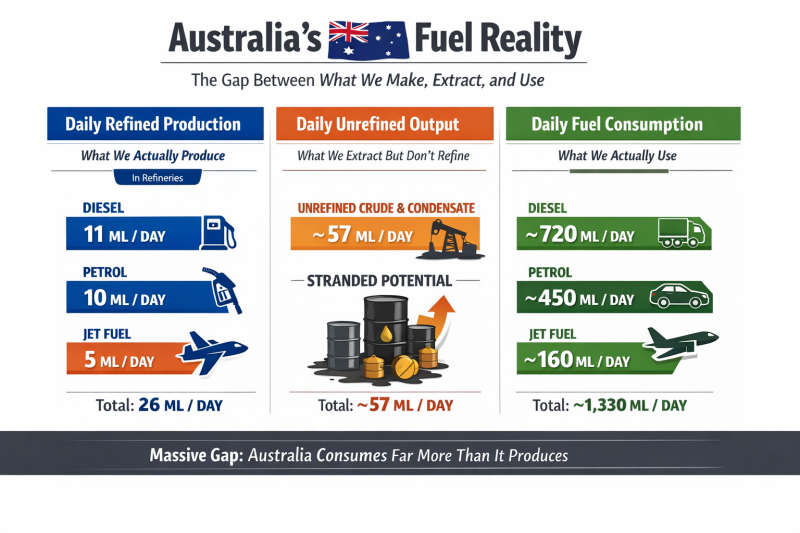
Australia produces about 26 ML/day of refined fuel and 57 ML/day of unrefined liquids, with 30–40 days of reserves. Most crude and condensate are exported, leaving limited domestic refining capacity.

What is the best six‑month plan aim to achieve?
To stabilise reserves, lift local production, and reduce import dependency while the sovereign refinery system is built. The goal is to extend reserves from ≈35 days to ≈55 days and raise refined output to ≈40 ML/day.

How will reserves be protected?
Non‑essential drawdown is frozen. Fuel is released in targeted pulses for freight, agriculture, emergency services, and defence. A priority ladder ensures essential sectors are supplied first.

How can local production
increase quickly?
Existing refineries (Geelong & Lytton) run in emergency mode with minor upgrades and broader crude acceptance. Redirecting condensate adds ≈5–10 ML/day, boosting refined output within six months. Our six month pplans helps assist with works required to the Geelong plant

What role does gas play in the plan?
Australia’s LNG exports are used as leverage in gas‑for‑fuel swaps with Japan, South Korea, Singapore, and India — securing diesel and jet fuel imports during supply shocks.
Australia’s tax system is widely viewed as complex, inefficient, and unfairly weighted, creating pressure on households and businesses. Key issues include:
-
Bracket creep pushing workers into higher tax bands
-
High effective tax rates on low and middle‑income earners
-
Multinational tax avoidance reducing national revenue
-
Over‑reliance on income tax instead of diversified revenue
-
Inefficient state taxes (stamp duty, payroll tax)
-
ATO enforcement gaps enabling fraud and non‑compliance
-
Complicated rules that burden small businesses and families
These issues contribute to cost‑of‑living pressures, stagnant wages, and reduced economic sovereignty.
the major problems in Australia’s housing system today
Australia faces a structural housing crisis driven by:
-
Chronic undersupply
-
Slow planning approvals
-
Investor‑driven price inflation
-
Construction bottlenecks
-
High land costs
-
Migration pressures outpacing housing capacity
-
Rising homelessness and rental stress
These issues are addressed in the 👉 Housing Reform & Modernisation page
Answer: Australians Unified supports a national, coordinated housing strategy focused on supply, affordability, and construction capability. Key reforms include:
-
Large‑scale land release
-
Modular and rapid‑build housing
-
National planning reform
-
Build‑to‑rent incentives
-
Anti‑hoarding rules for vacant land
-
Affordable housing targets for states
-
Stronger protections for renters
.What solutions does Australians Unified propose to reduce youth crime?
Answer: Australians Unified supports a whole‑of‑government prevention and intervention model that addresses root causes, not just symptoms. Key reforms include:
-
Early intervention programs in schools
-
Trauma‑informed mental health support
-
Youth engagement hubs and after‑school programs
-
Stronger family support services
-
Community‑based diversion programs
-
Workforce pathways for at‑risk youth
-
Better coordination between police, schools, and social services
How does housing and cost‑of‑living pressure contribute to youth crime?
Answer: Housing stress and financial pressure increase the risk of:
-
Family conflict
-
Homelessness
-
School disengagement
-
Exposure to unsafe environments
Australians Unified addresses these pressures through:
-
Affordable housing expansion
-
Modular and rapid‑build homes
-
Cost‑of‑living relief
-
Family support services

What economic reforms actually reduce inflation in Australia?
Answer: Inflation in Australia is driven by structural pressures, not just interest rates. Australians Unified supports a cross‑portfolio reform model that reduces inflation by lowering the real cost of doing business, increasing supply, and strengthening sovereign capability.
Key inflation‑reducing reforms include:
1. Tax Reform (Treasury)
-
Simplifying the tax system
-
Reducing bracket creep
-
Strengthening ATO enforcement
-
Cracking down on multinational tax avoidance
-
Incentives for sovereign manufacturing 👉 Treasury Reform page https://www.australiansunified.com.au/treasury-reform
2. Housing Supply Expansion (Housing & Infrastructure)
-
Large‑scale land release
-
Modular construction
-
Faster planning approvals
-
Build‑to‑rent incentives
-
Anti‑land‑hoarding rules 👉 Housing Reform page https://www.australiansunified.com.au/housing-reform
3. Energy Cost Reduction (Energy & Climate)
-
National super‑grid
-
Renewable export corridors
-
Domestic energy security
-
Sovereign battery and hydrogen capability 👉 Energy & Climate Reform page https://www.australiansunified.com.au/climate-reform
4. Manufacturing & Supply Chain Sovereignty (Industry)
-
Local production of critical goods
-
National manufacturing revival
-
Regional industry zones
-
Reduced import dependency 👉 Industry Reform page https://www.australiansunified.com.au/industry-reform
5. Workforce & Migration Alignment (Immigration)
-
Capacity‑linked migration
-
Skills‑first intake
-
Workforce mapping
-
Youth employment pathways 👉 Immigration Reform page https://www.australiansunified.com.au/immigration-reform
6. Cost‑of‑Living Relief (Social Services)
-
Reducing essential service costs
-
Strengthening family support
-
Improving wage–productivity alignment 👉 Cost of Living Reform page https://www.australiansunified.com.au/cost-of-living
7. National Infrastructure Acceleration (Infrastructure)
-
Faster approvals
-
Sovereign construction capability
-
Transport corridor upgrades 👉 Infrastructure Reform page https://www.australiansunified.com.au/infrastructure-reform
8. Debt & Fiscal Integrity (Finance)
-
Long‑term investment planning
-
Reducing waste and duplication
-
Transparent budgeting 👉 Finance Reform page https://www.australiansunified.com.au/finance-reform
Summary
Inflation falls when Australia:
-
Produces more locally
-
Builds housing faster
-
Reduces energy costs
-
Aligns migration with capacity
-
Simplifies taxation
-
Strengthens supply chains
-
Reduces government waste
This is the Australians Unified economic stabilisation model.

Treasury‑Style Inflation Reduction Costing Sheet
Australians Unified — 10‑Year Structural Inflation Reduction Model
1. Baseline Inflation Drivers (Current State)
Structural pressures increasing inflation:
-
High energy input costs
-
Housing undersupply
-
Supply chain dependency
-
Tax system inefficiency
-
Workforce mismatch
-
High migration relative to capacity
-
Low sovereign manufacturing
-
Infrastructure lag
-
Rising government waste and duplication
Baseline 10‑year inflation cost to economy: $310B (lost productivity, higher prices, supply shocks, wage‑price instability)
2. Reform Package — Inflation Reduction Levers
A. Tax Reform (Treasury)
Cost: $12B Savings / Revenue Recovery: $48B Net Impact: +$36B Inflation Effect: ↓ reduces structural inflation by lowering business costs and increasing disposable income Reforms:
-
Simplify tax system
-
Reduce bracket creep
-
Strengthen ATO enforcement
-
Crack down on multinational avoidance
B. Housing Supply Expansion (Housing & Infrastructure)
Cost: $22B Savings: $95B Net Impact: +$73B Inflation Effect: ↓ reduces rental and mortgage pressure, stabilises CPI Reforms:
-
Modular construction
-
Land release
-
Planning reform
-
Build‑to‑rent incentives
C. Energy Cost Reduction (Energy & Climate)
Cost: $28B Savings: $140B Net Impact: +$112B Inflation Effect: ↓ lowers input costs across all industries Reforms:
-
National super‑grid
-
Renewable export corridors
-
Domestic energy security
-
Battery & hydrogen capability
D. Manufacturing Sovereignty (Industry)
Cost: $16B Savings: $62B Net Impact: +$46B Inflation Effect: ↓ reduces import dependency and supply shocks Reforms:
-
Local production of critical goods
-
Regional industry zones
-
Supply chain resilience
E. Workforce & Migration Alignment (Immigration)
Cost: $6B Savings: $31B Net Impact: +$25B Inflation Effect: ↓ stabilises labour market, reduces wage‑price volatility Reforms:
-
Capacity‑linked migration
-
Skills‑first intake
-
Workforce mapping
F. Cost‑of‑Living Relief (Social Services)
Cost: $9B Savings: $18B Net Impact: +$9B Inflation Effect: ↓ reduces household pressure and improves wage–productivity alignment

G.
Infrastructure Acceleration (Infrastructure)
Cost: $14B Savings: $55B Net Impact: +$41B Inflation Effect: ↓ reduces bottlenecks and business costs
H. Fiscal Integrity & Waste Reduction (Finance)

National Outcomes (10‑Year Projection)
-
CPI stabilised within target band
-
Lower household cost pressures
-
Stronger wage–productivity alignment
-
Reduced import dependency
-
Cheaper energy and construction inputs
-
Increased sovereign capability
-
Higher GDP growth
-
Lower structural unemployment
-
Stronger national resilience

Overall Fiscal Outcome
-
Debt manageable and proportionally smaller
-
Tax pressure reduced without cutting services
-
GDP and wages rise through sovereign ownership + reinvestment
-
Fiscal multiplier: 1.8× — every $1 invested returns $1.80 in national value
-
Outcome: A high‑wage, high‑productivity, low‑debt sovereign economy.

Where does Australia stand in this Global divide
STRATEGIC POSITIONING
Australia stands at the fault line of a divided world. Trade wars, currency shifts, military realignments, and digital fragmentation are reshaping the global order. As blocs form and alliances harden, Australia must choose not just sides — but sovereignty. We choose capability. We choose resilience. We choose to build a sovereign economy powered by secure supply chains, unified Defence corridors, and AI‑enabled national infrastructure.
This is not the time to wait. It is the time to mobilise. Through Indo-Pacific partnerships, sovereign manufacturing, and strategic export corridors, Australia rises as a trusted regional power — confident, technologically advanced, and economically independent. We protect our interests, defend our values, and unify our systems. This is how we secure Australia’s future — not by following, but by leading.
How Government Ownership & Tax Reform Drive GDP and Wage Growth
1️⃣ Debt Position (10‑Year Outlook)
-
Starting debt (2026): ~ $950 B
-
Projected debt (2036): $1.05 T–$1.15 T
-
Debt‑to‑GDP ratio: falls 38% → 28% as GDP grows faster than borrowing
-
Debt servicing costs: drop 20–25% due to:
-
Lower‑yield sovereign bonds issued by the Government Bank
-
Returns from sovereign enterprises and the Sovereign Superannuation Company
-
-
Outcome: Debt becomes cheaper, safer, and proportionally smaller.
2️⃣ Tax Reform Impact
-
Corporate tax reduced by 3–5% → boosts reinvestment and expansion
-
Simplified GST & payroll tax → lower compliance costs
-
Lost tax revenue replaced by:
-
Dividends from sovereign enterprises
-
Bond yields from the Government Bank
-
Export profits from sovereign manufacturing & energy
-
-
Outcome: Lower taxes without reducing government revenue.
3️⃣ GDP Growth (10‑Year Projection)
-
Sovereign enterprises: + $490 B–$710 B
-
Private‑sector expansion: + $1.0 T–$1.95 T
-
Efficiency savings: + $600 B–$870 B
-
Total GDP uplift: + $2.1 T–$3.5 T
-
Annual GDP growth: 3.2%–3.8%, consistently above debt growth
-
Outcome: A larger, more productive economy with sovereign revenue streams.
4️⃣ Wage Growth
-
Productivity gains from automation, national grids, and sovereign investment
-
Lower business tax → more room for wage increases
-
Public‑sector stability through efficiency savings
-
Median wage (2036): $110K–$125K (up from ~$85K in 2026)
-
Outcome: Real wages rise 22–28% over the decade.
5️⃣ Overall Fiscal Outcome
-
Debt manageable and proportionally smaller
-
Tax pressure reduced without cutting services
-
GDP and wages rise through sovereign ownership + reinvestment
-
Fiscal multiplier: 1.8× — every $1 invested returns $1.80 in national value
-
Outcome: A high‑wage, high‑productivity, low‑debt sovereign economy.
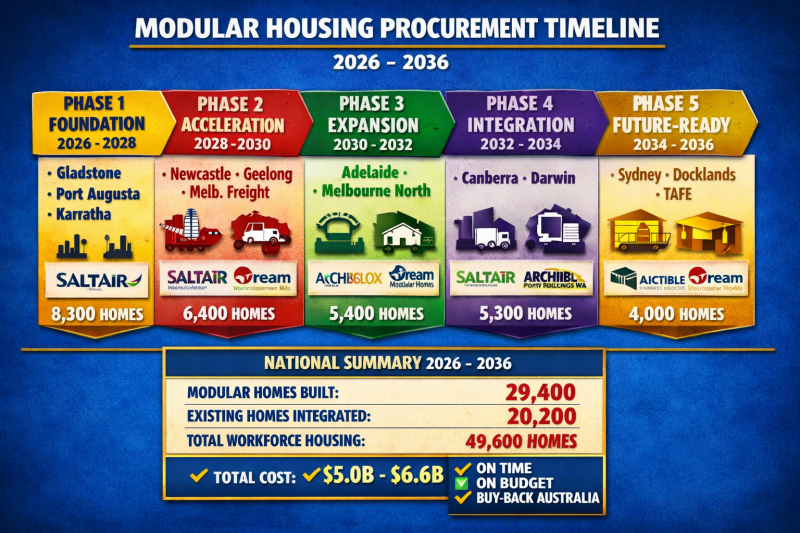
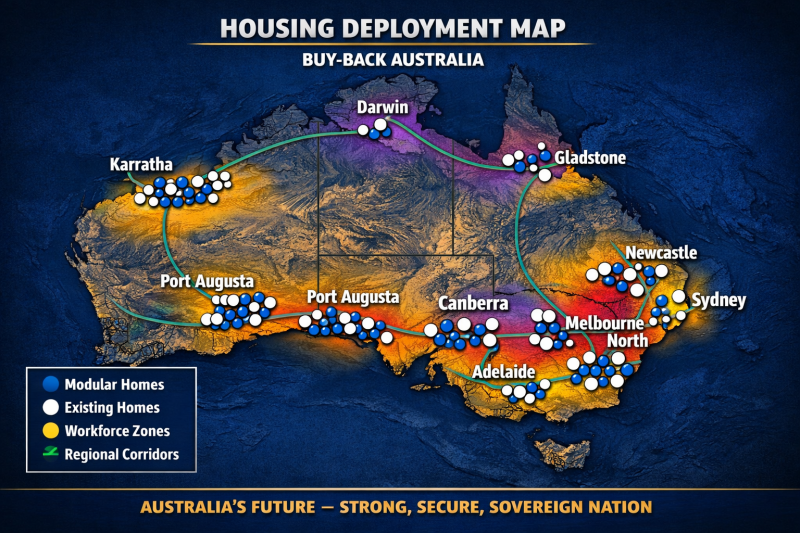
Modular Housing Procurement Timeline (2026–2036)
Who builds what, when, and in which region
PHASE 1 — FOUNDATION (2026–2028)
Regions: Gladstone • Port Augusta • Karratha
Purpose: Energy & Super‑Grid workforce villages
Companies Delivering:
-
Saltair Modular — primary contractor (fast, government‑grade units)
-
Fox Modular — rapid‑deploy workforce units
-
Portable Buildings WA — remote‑area accommodation
Output:
-
8,300 modular homes delivered
-
6,200 existing homes integrated
PHASE 2 — ACCELERATION (2028–2030)
Regions: Newcastle • Geelong • Melbourne Freight Corridor
Purpose: Transport & Ports redevelopment
Companies Delivering:
-
Saltair Modular — port‑side housing clusters
-
Dream Modular Homes — regional logistics housing
-
Fox Modular — rail corridor workforce units
Output:
-
6,400 modular homes delivered
-
4,400 existing homes integrated
PHASE 3 — EXPANSION (2030–2032)
Regions: Adelaide • Melbourne North
Purpose: Manufacturing & Robotics precincts
Companies Delivering:
-
Archiblox — premium ESG‑aligned industrial housing
-
Saltair Modular — mid‑density modular estates
-
Dream Modular Homes — off‑grid support housing
Output:
-
5,400 modular homes delivered
-
3,800 existing homes integrated
PHASE 4 — INTEGRATION (2032–2034)
Regions: Canberra • Darwin
Purpose: Defence & Cyber Command housing
Companies Delivering:
-
Saltair Modular — secure defence‑grade units
-
Archiblox — cyber‑facility adjacent housing
-
Portable Buildings WA — rapid‑deploy defence logistics housing
Output:
-
5,300 modular homes delivered
-
3,100 existing homes integrated
PHASE 5 — FUTURE‑READY (2034–2036)
Regions: Sydney CBD • Docklands • National TAFE Centres
Purpose: Finance, Education & Training
Companies Delivering:
-
Archiblox — urban ESG‑aligned modular housing
-
Saltair Modular — high‑density modular infill
-
Dream Modular Homes — regional TAFE housing
Output:
-
4,000 modular homes delivered
-
2,700 existing homes integrated
NATIONAL SUMMARY (2026–2036)
Total Modular Homes: 29,400
Total Existing Homes Integrated: 20,200
Total Workforce Housing Delivered: 49,600 homes
Total Cost: $5.0B–$6.6B
Budget Fit: ✔ Within existing Buy‑Back Australia capital envelope
🟦 How do we deal with the COST‑OF‑LIVING
COST‑OF‑LIVING MASTER PLAN Lower prices • Stronger supply chains • Cheaper energy • Fairer tax
A STRONGER, FAIRER, MORE AFFORDABLE AUSTRALIA
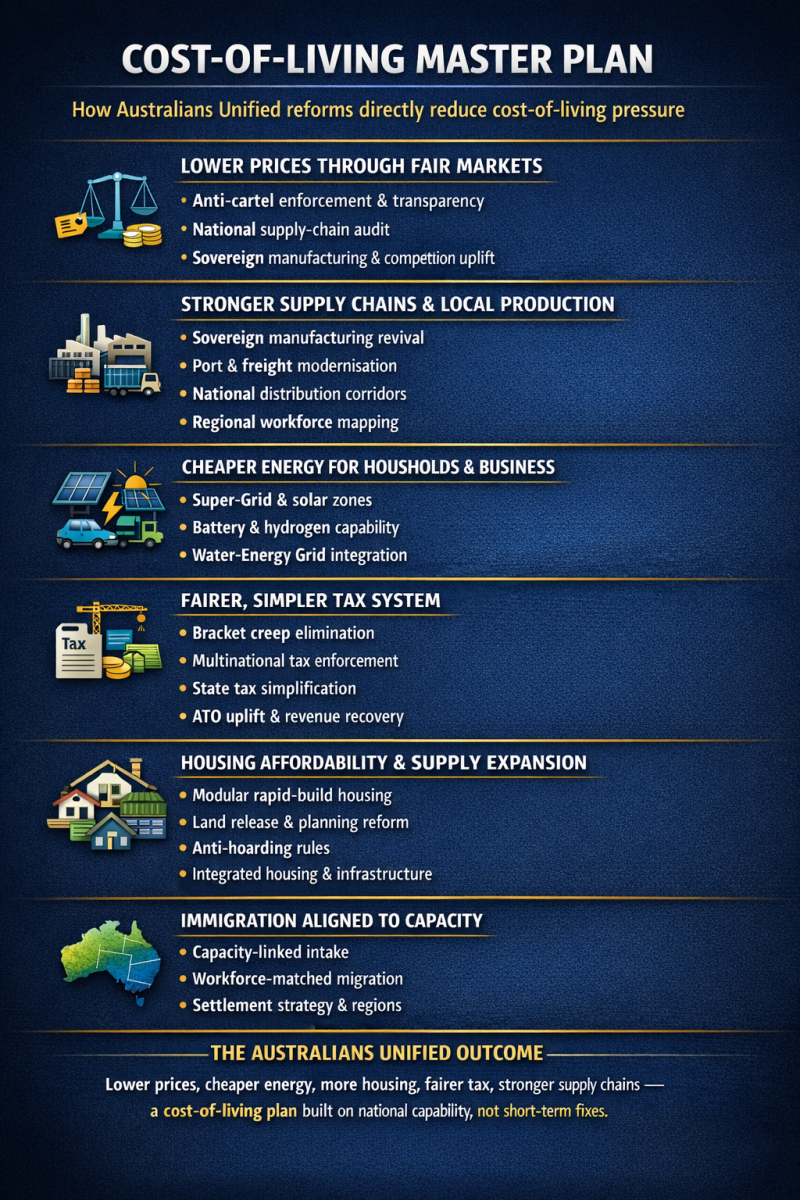

1. PRICE CONTROLS & COMPETITION
Australians Unified reforms directly target the structural drivers of inflated prices:
-
Anti‑cartel enforcement to break supermarket and supply‑chain concentration (FAQ: cost‑of‑living pressure)
-
Transparent pricing rules across groceries, fuel, freight, and essential goods
-
National supply‑chain audit to expose bottlenecks and price‑gouging
-
Competition uplift

2. SUPPLY CHAIN REFORM
Your reforms strengthen domestic capability, so Australia is less exposed to global shocks:
-
Sovereign manufacturing revival (EVs, batteries, defense, food processing) (FAQ: EV manufacturing, sovereign capability)
-
Port, freight, and logistics modernization to reduce transport costs
-
National distribution corridors aligned with the Water Grid & Super‑Grid
-
Regional workforce mapping to ensure labor supply meets production needs (FAQ: immigration pressure, workforce mismatch)
-
Domestic manufacturing uplift
-
Port & freight modernization
-
Cold‑chain & food‑chain reliability
-
National distribution corridors

3. ENERGY COST REDUCTION
Australians Unified reforms directly reduce energy bills by fixing structural energy issues:
-
Super‑Grid rollout to stabilize supply and lower wholesale prices (FAQ: energy debate)
-
Solar zones + storage to deliver abundant, low‑cost domestic energy
-
Sovereign battery and hydrogen capability to reduce import costs
-
Water‑Energy Grid integration to secure long‑term national resilience (FAQ: national water & energy grid)

4. TAX SIMPLIFICATION
Your tax reforms directly relieve household and business pressure:
-
Bracket creep elimination to stop silent tax increases (FAQ: tax system problems)
-
Multinational tax enforcement to ensure big corporations pay their share
-
State tax simplification to reduce duplication and compliance costs
-
ATO uplift to recover lost revenue and reduce pressure on ordinary taxpayers (FAQ: GDP vs debt, ATO uplift)