EMPLOYMENT AND WORKPLACE RELATIONS PORTFOLIO
Employment
Reform Stream: Workforce Transition
-
Apprenticeships and micro‑credentials
-
Employer partnerships
-
National capability alignment Infographic Tile: Employment Reform Tile
Australians Unified – Employment, Skills, Workplace Relations & Fair Work
The Employment and Workplace Relations Portfolio leads Australia’s national approach to jobs, skills, workplace laws, industrial relations, and fair employment practices. It ensures safe, productive, and equitable workplaces while supporting strong labour markets, economic participation, and workforce resilience.
The portfolio works with employers, unions, workers, industry groups, training providers, and government agencies to strengthen job creation, workplace protections, and national productivity.
OUR ROLE
The Employment and Workplace Relations Portfolio exists to:
-
Strengthen national workplace laws and protections
-
Support job creation, workforce participation, and productivity
-
Regulate industrial relations and enterprise bargaining
-
Improve workplace safety, fairness, and compliance
-
Support skills development and workforce transitions
-
Provide labour market insights and economic analysis
-
Partner with employers, unions, and communities
The portfolio ensures Australia’s workplaces are fair, safe, and future‑ready.


OUR STRENGTHS
Workforce & Regulatory Strengths
-
Trusted national workplace relations and safety frameworks
-
Strong partnerships with employers, unions, and industry
-
Deep expertise in labour market analysis and policy
-
Established compliance and enforcement capability
-
National leadership in fair work and employment standards
Sovereign Strengths
-
Critical to national productivity and economic stability
-
Essential for worker wellbeing and social cohesion
-
Supports long‑term workforce resilience and equity

OUR WEAKNESSES
Structural Weaknesses
-
Fragmented data systems across labour market agencies
-
Slow modernisation of digital workplace compliance tools
-
Limited long‑term funding certainty for workforce programs
-
Under‑resourced support for vulnerable workers
-
Inconsistent employer engagement across regions
Operational Weaknesses
-
Workforce shortages in specialist regulatory roles
-
Rising complexity of modern workplace arrangements
-
Limited outreach to remote and First Nations communities
-
Increasing demand for rapid workplace dispute resolution

OUR THREATS
External Threats
-
Economic volatility affecting employment stability
-
Skills shortages across key industries
-
Workplace exploitation and non‑compliance
-
Technological disruption impacting job security
Internal Threats
-
Resource constraints
-
Outdated digital systems
-
Workforce fatigue and retention challenges
-
Limited surge capacity for major industrial events
Employment Portfolio Integration
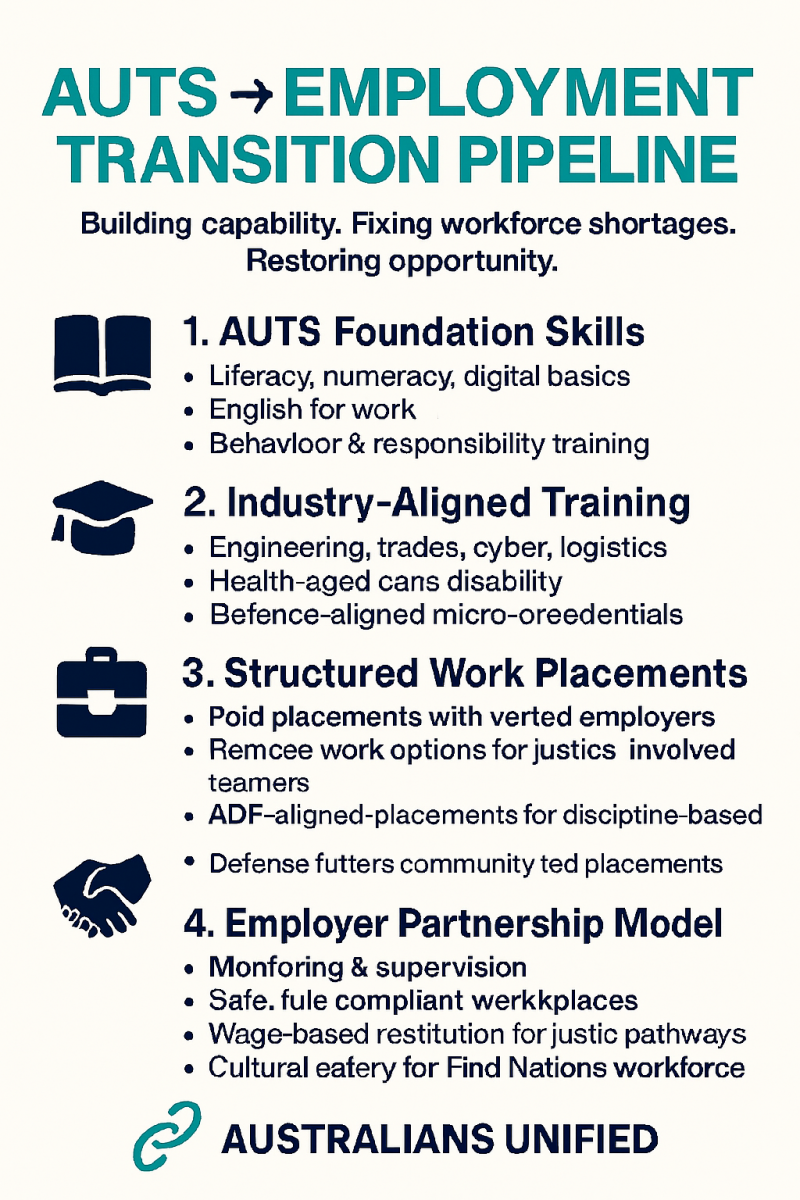
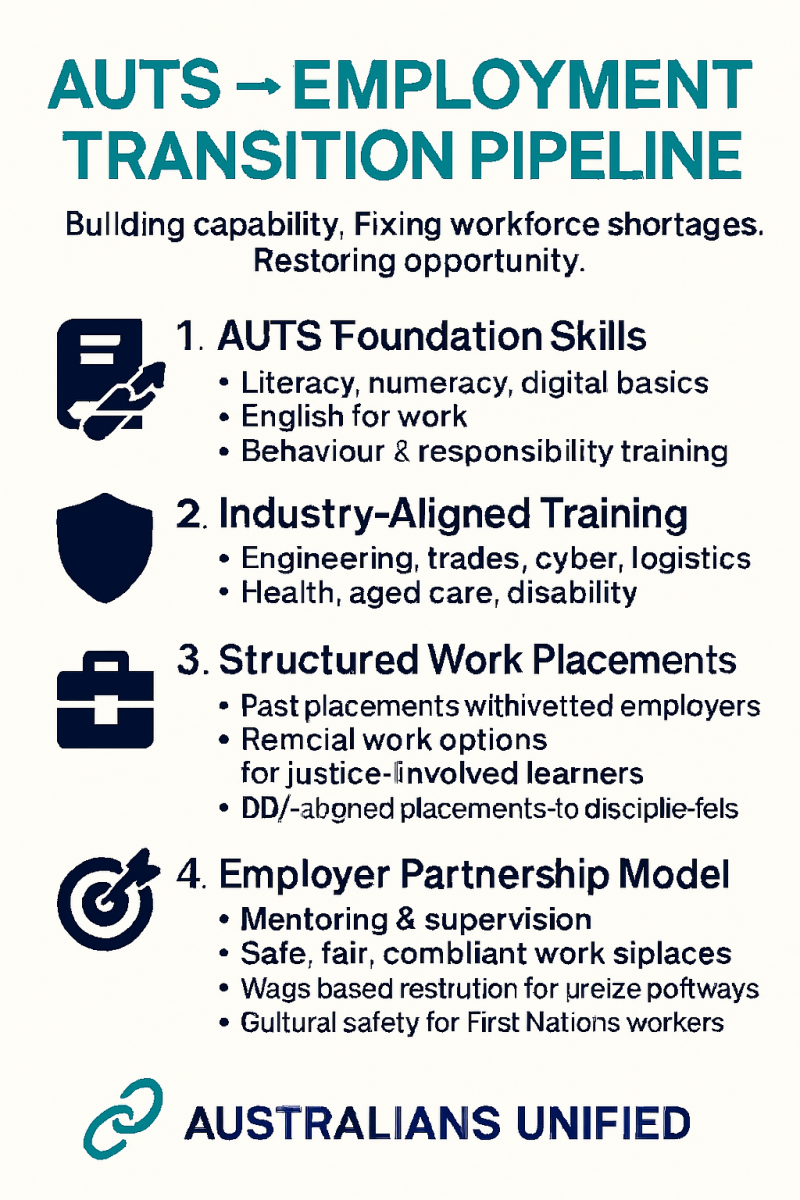
Employment is the national engine room that turns training into capability, justice pathways into jobs, and industry shortages into opportunity.
Policy Upgrades Driving the System
-
Modernised Fair Work laws and faster dispute resolution
-
Stronger protections for gig‑economy and vulnerable workers
-
National pipelines for engineering, trades, cyber, health, logistics, aged care
-
Integrated workforce planning with Defence, Infrastructure, Energy, Industry
-
Digital compliance tools for safer, fairer workplaces
-
Regional workforce programs to fix shortages outside metro areas
-
Employer incentives for structured placements and capability alignment
-
Wage‑based restitution for justice‑involved workers
-
First Nations community‑led employment pathways
OUR OPPORTUNITIES
Strategic Opportunities
-
Modernise national workplace relations and compliance systems
-
Strengthen workforce participation and job creation programs
-
Expand skills development and transition pathways
-
Improve First Nations employment partnerships
-
Enhance international labour standards leadership
Operational Opportunities
-
Recruit and retain specialist workplace relations staff
-
Improve digital tools for employers and workers
-
Strengthen partnerships with industry and unions
-
Expand community and regional engagement
-
Australian‑first workforce priority language
-
Migration impact analysis on employment and wages
-
Stronger sovereign capability framing (manufacturing, energy, defence)
-
Explicit red‑tape reduction for employers
-
Cost‑of‑living relief measures tied to employment
-
Clearer stance on union power and workplace bargaining
-
More direct accountability measures for government departments
E
Employment is the bridge between training and national capability.
-
Justice → Employment Wage‑based restitution, remote work, reduced‑sentence pathways
-
Education → Employment AUTS micro‑credentials, apprenticeships, digital literacy
-
Defence → Employment ADF Reserve pathways, logistics, cyber, engineering roles
-
Social Services → Employment Housing, mental health, reintegration support
-
First Nations → Employment Elders‑led mentoring, On‑Country placements, cultural safety
Outcome: A unified employment system that restores dignity, fills workforce gaps, and builds national capability.
National Workforce Capability Board
A unified board ensuring every state and territory drives capability, placements, and workforce reform.
Board Composition
-
National Chair – Australians Unified Workforce Commissioner
-
Deputy Chair – First Nations Capability Lead
-
State & Territory Representatives:
-
Victoria – Workforce & Industry Integration Lead
-
New South Wales – Skills & Training Systems Lead
-
Queensland – Regional Workforce & Resources Lead
-
Western Australia – Mining, Energy & Engineering Capability Lead
-
South Australia – Defence & Manufacturing Lead
-
Tasmania – Community & Regional Development Lead
-
Northern Territory – First Nations Employment & On‑Country Lead
-
ACT – Public Sector & National Systems Lead
-
Board Mandate
-
Align AUTS, TAFE, universities, and industry training
-
Oversee national workforce forecasting and capability mapping
-
Approve employer partnerships and placement standards
-
Ensure cultural safety and First Nations governance
-
Coordinate Justice → Employment transitions
-
Monitor Fair Work compliance and workplace safety
-
Drive regional workforce development
Outcome
A single national system where every learner, every employer, every state, and every portfolio contributes to Australia’s long‑term capability.

CONDENSED YEARLY COSTING MODEL — EMPLOYMENT & WORKPLACE RELATIONS PORTFOLIO
Baseline + Uplift Investment Framework
BASELINE FUNDING (Already Provided)
-
Core employment & workplace relations operations: $0.52B
-
Workplace safety, compliance & regulation: $0.22B
-
Labour market programs & analysis: $0.18B
Total Baseline Funding:
$0.92B per year
PHASE 1 — FOUNDATION (Years 1–2)
Annual uplift: $0.60B – $0.82B 2‑year uplift total: $1.20B – $1.64B
PHASE 2 — ACCELERATION (Years 2–4)
Annual uplift: $0.82B – $1.10B 3‑year uplift total: $2.46B – $3.30B
PHASE 3 — EXPANSION (Years 4–6)
Annual uplift: $1.05B – $1.40B 2‑year uplift total: $2.10B – $2.80B
PHASE 4 — FUTURE‑READY (Years 6–10)
Annual uplift: $1.30B – $1.70B 4‑year uplift total: $5.20B – $6.80B
TOTAL INVESTMENT SUMMARY
6‑YEAR TOTAL
-
Uplift: $5.76B – $7.74B
-
Baseline: $5.52B
Total 6‑Year Investment:
$11.28B – $13.26B
10‑YEAR TOTAL
-
Uplift: $10.96B – $14.44B
-
Baseline: $9.20B
Total 10‑Year Investment:
$20.16B – $23.64B
THE FUTURE‑READY EMPLOYMENT & WORKPLACE RELATIONS PORTFOLIO
A national blueprint for fair, safe, and productive workplaces
1. FASTER, MORE EFFECTIVE WORKPLACE SYSTEMS
Strengthening national employment capability
Key Actions
-
Modern digital workplace relations systems
-
Faster dispute resolution and compliance pathways
-
Improved labour market forecasting tools
-
Strengthened coordination with industry and unions
Outcome: A more agile, responsive national employment system.
2. STRONGER SOVEREIGN WORKPLACE CAPABILITY
Building Australian capability for fair and productive work
Key Actions
-
Specialist workplace relations and safety teams
-
National labour market data and modelling platform
-
Strengthened oversight and governance
-
Expanded workforce planning and transition programs
Outcome: A more resilient, future‑focused employment system.
3. A MODERN, RESILIENT WORKPLACE RELATIONS WORKFORCE
Supporting the people who support Australia’s workers
Key Actions
-
Workforce wellbeing and retention programs
-
Specialist training pathways
-
Diversity and inclusion initiatives
-
Modern digital and analytical tools
Outcome: A strong, supported workplace relations workforce.
4. BETTER INTEGRATION WITH GOVERNMENT, INDUSTRY & WORKERS
One national employment and workplace relations ecosystem
Key Actions
-
Integrated data‑sharing platforms
-
Stronger partnerships with employers, unions, and training providers
-
National community and regional engagement
-
Shared analytics and intelligence systems
Outcome: A more coordinated, community‑connected employment network.
5. A FAIRER, SAFER, MORE PRODUCTIVE AUSTRALIA
Supporting workers, employers, and communities
Key Actions
-
Stronger workplace protections and safety standards
-
Equity‑focused employment programs
-
First Nations community‑led employment initiatives
-
Public transparency and open data
Outcome: A more inclusive, skilled, and productive nation.