This is where our journey begins. Get to know our business and what we do, and how we're committed to quality and great service. Join us as we grow and succeed together. We're glad you're here to be a part of our story.

Fair Work Ombudsman (FWO)
Policy Change Priorities
-
Mandate digital payroll submission for high‑risk industries to detect wage theft early.
-
Strengthen penalties for repeat offenders and introduce public naming for systemic breaches.
-
Create a national vulnerable‑worker protection unit with multilingual support.
-
Expand proactive compliance audits in gig, hospitality, agriculture, and care sectors.
-
Integrate FWO data with migration, tax, and safety regulators for cross‑agency enforcement.

Workplace Health & Safety Regulators
Policy Change Priorities
-
National harmonisation of WHS laws to remove state‑by‑state inconsistencies.
-
Mandatory digital incident reporting with real‑time analytics.
-
Introduce national psychosocial safety standards for modern workplaces.
-
Strengthen penalties for unsafe labour‑hire practices and high‑risk industries.
-
Create a national WHS training accreditation system to ensure quality and consistency.

Workplace Gender Equality / Inclusion Units
Policy Change Priorities
-
Mandate gender‑pay‑gap action plans for medium and large employers.
-
Introduce national reporting on flexible‑work uptake and barriers.
-
Strengthen protections against workplace harassment with mandatory prevention training.
-
Expand support for women in STEM, Defence, and energy sectors through targeted pipelines.
-
Require intersectional workforce reporting (gender, disability, First Nations, CALD).

Jobs & Skills Australia (JSA)
Policy Change Priorities
-
Mandate real‑time labour‑market data sharing across states, industry, and education providers.
-
Create national workforce pipeline plans for Defence, energy, construction, health, and digital sectors.
-
Legislate a unified skills taxonomy so training, migration, and employment services use the same definitions.
-
Require annual national workforce forecasting with public dashboards for transparency.
-
Integrate JSA with Workforce Australia to close the gap between skills supply and job placement.

Workforce Australia / Employment Services
Policy Change Priorities
-
Shift from compliance‑driven to outcomes‑driven service delivery (employment, retention, skills gain).
-
Introduce tiered service models for youth, long‑term unemployed, and regional communities.
-
Replace outdated points‑based activation systems with personalised digital pathways.
-
Mandate provider performance transparency through public scorecards.
-
Integrate employment services with JSA and TAFE to create seamless training‑to‑employment pipelines.

Workplace Relations / Industrial Relations
Policy Change Priorities
-
Simplify awards and agreements to reduce complexity for small and medium businesses.
-
Strengthen wage‑theft enforcement powers with mandatory digital payroll records.
-
Modernise dispute‑resolution processes with digital lodgement, triage, and fast‑track pathways.
-
Create a national framework for gig‑economy workers covering safety, minimum standards, and insurance.
-
Introduce portable entitlements for industries with high mobility (care, construction, gig work).

Fair Work Commission (FWC)
Policy Change Priorities
-
Digitise all case‑management systems to reduce delays and improve transparency.
-
Introduce statutory timeframes for dispute resolution to prevent backlog growth.
-
Expand arbitration powers for systemic underpayment and unsafe‑work matters.
-
Require annual reporting on dispute trends to inform national policy.
-
Create a unified IR knowledge hub for workers and employers.
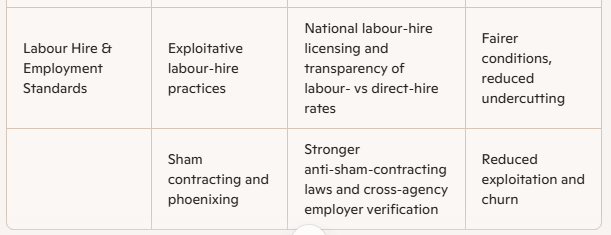
Labour Hire & Employment Standards
Policy Change Priorities
-
National labour‑hire licensing scheme with consistent standards.
-
Mandatory transparency of labour‑hire rates compared to direct‑hire rates.
-
Introduce portable leave entitlements for labour‑hire workers.
-
Strengthen enforcement against sham contracting and phoenixing.
-
Create a national employer‑verification system to prevent exploitation.

National Workforce Capability Board
A unified board ensuring every state and territory drives capability, placements, and workforce reform.
Board Structure
-
National Chair – Workforce Commissioner
-
Deputy Chair – First Nations Capability Lead
State & Territory Representatives
-
Victoria – Industry & Workforce Integration
-
New South Wales – Skills & Training Systems
-
Queensland – Regional Workforce & Resources
-
Western Australia – Mining, Energy & Engineering
-
South Australia – Defence & Manufacturing
-
Tasmania – Community & Regional Development
-
Northern Territory – First Nations Employment & On‑Country
-
ACT – Public Sector & National Systems
Board Mandate
-
Align AUTS, TAFE, universities, and industry
-
Oversee national workforce forecasting
-
Approve employer partnerships and placement standards
-
Ensure cultural safety and First Nations governance
-
Coordinate Justice → Employment transitions
-
Monitor Fair Work compliance and workplace safety
-
Drive regional workforce development
Outcome
A unified national employment system that:
-
Protects workers
-
Strengthens sovereign capability
-
Reduces fragmentation
-
Supports regional and First Nations communities
-
Ensures Australian skills meet Australian needs
-
Builds a future‑ready workforce for Defence, Energy, Infrastructure, and Industry
Employment & Workplace Relations – Integrated National Capability Model
Purpose
A national employment system that protects Australian workers, strengthens sovereign capability, reduces fragmentation, and ensures every state and territory contributes to a unified workforce pipeline.
Upgraded Policy Framework
These upgrades reflect the full content of your Employment reform pages and align with themes emphasised by One Nation and People First (e.g., national capability, worker protection, regional development, practical skills, reduced bureaucracy).
Workforce Capability & Sovereignty
-
National pipelines for engineering, trades, cyber, logistics, health, aged care
-
Stronger focus on sovereign manufacturing, energy independence, and Defence capability
-
Workforce planning integrated with Infrastructure, Energy, Defence, Industry, Education
Fair Work Modernisation
-
Faster dispute resolution
-
Stronger protections for gig‑economy and vulnerable workers
-
Digital compliance tools to reduce exploitation
-
Reduced red tape for small and medium employers
Employment Pathways
-
AUTS → Employment transition pipeline
-
Apprenticeships, micro‑credentials, and employer‑aligned training
-
Regional workforce programs to fix shortages outside metro areas
-
Justice → Employment pathways with wage‑based restitution
Cost‑of‑Living & Family Stability
-
Employment programs tied to housing, mental health, and family support
-
Regional job creation to reduce pressure on major cities
Migration & Workforce Balance
-
Workforce planning that considers migration impacts on wages, housing, and job availability
-
Australian‑first workforce priority language (non‑discriminatory, capability‑focused)
First Nations Employment
-
Elders‑led mentoring
-
On‑Country employment pathways
-
Cultural safety standards for all employers
Cross‑Portfolio Integration
Employment becomes the central engine connecting all capability portfolios.
Education → Employment
-
AUTS micro‑credentials
-
Digital literacy, English, numeracy
-
Industry‑aligned training streams
Justice → Employment
-
Education in custody
-
Remote work readiness
-
Reduced‑sentence pathways
-
Wage‑based restitution
-
Structured placements
Defence → Employment
-
ADF Reserve pathways
-
Cyber, logistics, engineering pipelines
-
Defence‑aligned micro‑credentials
Social Services → Employment
-
Housing, mental health, addiction support
-
Reintegration services
-
Family stability programs
Industry & Science → Employment
-
Sovereign manufacturing
-
Innovation hubs
-
Future‑industry capability
Infrastructure & Energy → Employment
-
Super‑Grid workforce
-
Construction, transport, renewables
-
Regional capability hubs
First Nations → Employment
-
Community‑led governance
-
Cultural safety
-
On‑Country training and jobs
What we do
We offer a range of specialized services tailored to meet your individual needs. Our approach is focused on understanding and responding to what you require, providing effective and practical solutions.
