🏛️ Australian Taxation Office (ATO)
A sovereign, simplified, fair taxation system that puts Australians first
The Australian Taxation Office is responsible for administering the nation’s taxation and superannuation systems. Under Australians Unified reforms — aligned with One Nation and People First principles — the ATO’s mandate is strengthened to ensure fair taxation, protection of national revenue, and elimination of loopholes that benefit foreign interests over Australian workers, families, and businesses.
WHAT THE ATO DOES NOW
Portfolio: Treasury Portfolio Agency: Australian Taxation Office (ATO)
Current responsibilities:
-
Administers Australia’s taxation and superannuation systems
-
Collects income tax, GST, PAYG, corporate tax and excise
-
Oversees superannuation compliance and retirement savings integrity
-
Detects and prevents tax evasion, avoidance and fraud
-
Supports individuals, businesses and tax professionals
-
Provides digital tax services (myGov, myTax, Business Portal)
-
Conducts audits, investigations and compliance programs
-
Advises Treasury on tax policy and revenue forecasting
Who the ATO serves:
-
Individuals and families
-
Small, medium and large businesses
-
Multinationals and investors
-
Tax agents and accountants
-
Superannuation funds
-
Government and Parliament
GENERAL OPERATIONS (CURRENT)
-
Processes tax returns and payments
-
Manages GST, PAYG and business tax systems
-
Conducts audits and compliance investigations
-
Oversees superannuation guarantee compliance
-
Supports digital identity and secure access systems
-
Provides guidance and education to taxpayers
-
Detects fraud, phoenix activity and financial crime
-
Works with Treasury, ASIC, APRA, ACCC and AUSTRAC
Operational characteristics:
-
High‑volume, high‑complexity national system
-
Heavy reliance on digital platforms and data
-
Strong compliance and enforcement capability
-
High public visibility and accountability
-
Central role in national revenue and economic stability
WHY CHANGE IS NEEDED
-
Legacy systems and slow workflows
-
Complex global tax environments
-
Rising cyber and financial crime
-
Fragmented data across government
-
High compliance burden
-
Need for real‑time forecasting
-
Growth of digital and platform‑based economies
Taxation reform
Stop the Erosion of Australia’s Tax Base
Higher Withholding Taxes on Offshore Profits
(From One Nation tax policy)
-
Raise withholding tax on profits transferred offshore to 20%
-
Raise withholding tax on interest income paid overseas to 30%
-
Introduce an operating profit ratio test to prevent transfer pricing abuse
-
Ensure profits generated in Australia stay in Australia
Purpose: Stop multinational tax leakage and protect national revenue.

STRENGTHS
-
Strong national mandate
-
Large, skilled workforce
-
Extensive data and digital infrastructure
-
High public trust in core systems
-
Strong compliance and enforcement capability

WEAKNESSES
-
Legacy systems and slow workflows
-
High administrative burden for businesses
-
Limited real‑time data integration
-
Complex tax legislation
-
Workforce shortages in digital and analytics roles

THREATS
-
Cybersecurity risks
-
Global tax competition and avoidance
-
Economic volatility
-
Digital platform and gig‑economy complexity
-
Financial crime and phoenix activity

OPPORTUNITIES
-
AI‑enabled compliance and forecasting
-
Unified national tax platform
-
Simplified business tax systems
-
Real‑time revenue intelligence
-
Stronger superannuation integrity
FUTURE MODEL (AI‑ENABLED, AUTOMATED, TRANSPARENT)
A. Unified National Tax & Revenue Platform
-
One integrated system for individuals, businesses and agents
-
Real‑time tax calculation and payment tracking
-
Automated pre‑filled returns for most taxpayers
-
Seamless integration with myGov and digital identity
B. AI‑Enabled Compliance & Fraud Detection
-
Predictive modelling for tax evasion and avoidance
-
Automated anomaly detection
-
Real‑time GST and PAYG monitoring
-
Faster, more accurate audits
C. Modernised Business Tax System
-
Simplified reporting for SMEs
-
Automated BAS and GST reconciliation
-
Digital invoicing and real‑time transaction data
-
Reduced administrative burden
D. Superannuation Integrity & Transparency
-
Real‑time super guarantee compliance
-
Automated employer reporting
-
Fraud and theft detection
-
Retirement savings forecasting tools
E. National Revenue Intelligence Network
-
Real‑time revenue dashboards
-
Integrated Treasury–ATO forecasting
-
Economic risk modelling
-
Transparent public reporting
F. Taxpayer Support & Education
-
Digital guidance tools
-
Multilingual and accessible services
-
Specialist support for vulnerable taxpayers
-
Community and industry partnerships

Simplify Corporate Tax & Replace Franking Credits
(From One Nation tax policy)
-
Reduce corporate tax rate to 25%
-
Replace franking credits with:
-
15% non‑refundable rebate for all taxpayers
-
Refundable rebate up to $10,000 for low‑income earners
-
-
Reduce administrative burden on companies and shareholders
-
Strengthen the corporate tax base by ending refund erosion

Abolish CGT Exemptions for Foreign Investors
(Directly from One Nation policy)
-
Remove CGT exemption for foreign investors holding portfolio interests
-
Ensure foreign investors pay tax on Australian gains
-
Restore fairness between domestic and foreign taxpayers

GST Reform — Australians First
(Based on your page content)
-
Raise GST to 12.5%
-
Return GST to pensioners annually to increase disposable income
-
Return GST to students to help pay down HECS debt
-
Create a GST hand‑back scheme for low‑income Australians
Purpose: Ensure GST reform benefits Australians, not government bureaucracy.

Strengthen ATO Enforcement & National Revenue Protection
Aligned sovereignty and anti‑avoidance stance:
-
Crack down on multinational avoidance
-
Expand real‑time fraud detection
-
Increase penalties for phoenix activity
-
Strengthen FIRB‑linked tax enforcement
-
Protect superannuation from foreign exploitation

FUTURE MODEL — ATO UNDER AUSTRALIANS UNIFIED REFORM
(Based on your page’s future model + policy overlay)
A. Unified National Tax & Revenue Platform
-
One integrated system for all taxpayers
-
Automated pre‑filled returns
-
Real‑time tax calculation and payment tracking
B. AI‑Enabled Compliance & Fraud Detection
-
Predictive modelling for avoidance
-
Real‑time GST/PAYG monitoring
-
Faster, more accurate audits
C. Modernised Business Tax System
-
Simplified SME reporting
-
Automated BAS and GST reconciliation
-
Reduced administrative burden
D. Superannuation Integrity
-
Real‑time SG compliance
-
Fraud detection
-
Retirement forecasting tools
E. National Revenue Intelligence Network
-
Treasury–ATO integrated forecasting
-
Real‑time dashboards
-
Transparent public reporting
F. Taxpayer Support & Education
-
Digital guidance tools
-
Multilingual services
-
Specialist support for vulnerable taxpayers
Preventing the Erosion of Profits Offshore
Higher Withholding Taxes on Offshore Profits
We will raise the withholding tax rate on profits transferred to treaty countries to 20% and on interest income paid to all countries to 30%. This will prevent capital from leaving Australia and ensure that profits generated domestically contribute to our economy, rather than being funnelled offshore.
Additionally, an operating profit ratio test will be introduced to further strengthen transfer pricing rules and prevent the leakage of profits abroad.
Reducing Corporate Tax and Replacing Franking Credits
Australia’s corporate tax system will be simplified. The corporate tax rate will be lowered to 25%. In place of franking credits, we will introduce a non-refundable
rebate of 15% for all taxpayers, or a refundable rebate of up to $10,000 for low-income earners.
While this may appear to be a tax cut, it is expected to be revenue neutral, as the decision by Peter Costello to refund imputation tax credits has resulted in significant tax erosion. Estimates vary, but Australia’s net company tax rate is closer to 15 per cent and is expected to decrease further. This is because when the decision was made to refund franking credits, superannuation had $500 billion in funds under management. Today it has $3.5 trillion in funds under management and is expected to reach $10 trillion before 2050. Paying 30 cents at the company level, only to refund half of that, creates unnecessary paperwork for the company and shareholders and is eroding the company tax base.
5. Abolish Capital Gains Tax (CGT) Exemptions for Foreign Investors: The CGT exemption for foreign investors holding portfolio interests in non-real assets (S855 1997 ITAA) will be removed. This change will ensure that foreign investors are subject to capital gains tax on their investments, contributing fairly to Australia’s tax base and helping to address the imbalance between domestic and foreign tax contributions.
With over $3 trillion in superannuation, Australia does not need to provide tax exemptions to foreign interests to “attract capital.” The most sustainable form of capital is the type derived from Australian earnings. The words of our National Anthem reflect our values: “wealth for toil,” not “wealth for foreign capital.”
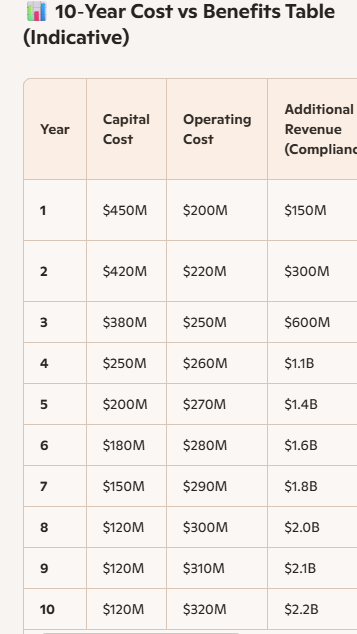
AUSTRALIANS UNIFIED — ATO REFORM SUMMARY
Our tax system must:
-
Protect Australian revenue
-
Prioritise Australian workers and families
-
Stop foreign exploitation
-
Simplify compliance
-
Strengthen national sovereignty
-
Modernise digital systems
-
Reduce burden on small business
Over 10 years, the ATO reform package delivers:
-
$5.09B in total costs (within existing budget envelopes)
-
$15.50B in total benefits
-
$10.41B net positive return
-
Break‑even in Year 3
-
Strong positive returns from Year 4 onward
This aligns with the ATO’s current direction and the reform logic on your Australians Unified page .
Oliver Hartman
How the supergrid transforms
Debt, Tax, GDP & Wage Dynamics (2026–2036)
How Sovereign Ownership and Smarter Tax Policy Strengthen Australia’s Economy
1️⃣ Debt Position
-
Starting national debt (2026): ≈ $950 B
-
Projected debt (2036): ≈ $1.05 T – $1.15 T → Debt grows modestly but remains stable as sovereign enterprises generate offsetting revenue.
-
Debt‑to‑GDP ratio: falls from 38 % → 28 % as GDP expands faster than borrowing.
-
Debt servicing: reduced by 20–25 % through lower bond yields from the Government Bank and sovereign investment returns.
2️⃣ Tax Reform Impact
-
Lower corporate tax (‑3 % to ‑5 %) encourages reinvestment and expansion.
-
Simplified GST and payroll tax bands reduce compliance costs.
-
Sovereign dividends and bond yields replace lost tax revenue, keeping the budget balanced.
-
Net fiscal neutrality: government revenue stays steady while private‑sector productivity rises.
3️⃣ GDP Growth — 10-Year Projection (2026–2036)
-
Sovereign Enterprises Contribution: +$490 B–$710 B from government-owned energy, water, manufacturing, finance, and defense corporations.
-
Private-Sector Expansion: +$1.0 T–$1.95 T from lower tax, cheaper energy, green-steel manufacturing, EV production, and export growth.
-
National Efficiency Savings: +$600 B–$870 B from reduced insurance risk, logistics optimization, regulatory automation, and water-grid stability.
-
Total GDP Uplift: +$2.1 T–$3.5 T added to the economy over the decade.
-
Annual Growth Rate: Sustained 3.2%–3.8% growth—outpacing debt and enhancing productivity.
-
Economic Engine: Sovereign ownership + lower tax + national grids = a self-reinforcing growth loop.
4️⃣ Wage Growth
-
Higher productivity from automation and sovereign investment lifts real wages by 22–28 % over the decade.
-
Reduced business tax burden allows employers to increase pay and hire more staff.
-
Public‑sector wage stability maintained through efficiency savings and reinvestment.
-
Median wage (2036): projected $110 K–$125 K, up from ~$85 K in 2026.
5️⃣ Overall Fiscal Outcome
-
Debt remains serviceable and proportionally smaller.
-
Tax pressure eases without cutting essential services.
-
GDP and wages rise through sovereign ownership and reinvestment.
-
Australia’s fiscal multiplier: 1.8× — every $1 invested returns $1.80 in national value.