DEPARTMENT OF EDUCATION PORTFOLIO
Simplified accountability mapping for Australian education
Australians Unified introduces clear, unified accountability principles across every tier of the education and lifelong learning portfolio. Every national initiative must answer a simple standard: who sets direction, who funds, who delivers, and who owns the ultimate outcome.
Australians Unified accountability framework
- Strategy owner: Identifies who sets strategic direction across national schooling, TAFE, and early childhood.
- Funding owner: Clarifies federal, state, or shared fiscal responsibility.
- Delivery owner: Specifies front-line service providers, schools, councils, and registered training organisations.
- Accountability owner: Demands transparent responsibility for student outcomes, completion rates, and institutional performance.
Moving from traditional funding pipelines to our unified model—Strategy → Funding → Delivery → Outcomes → Accountability → Continuous Improvement—ensures our curriculum streams, AUTS transition programs, and vocational pathways deliver measurable capability for every Australian.


OUR STRENGTHS
Educational & System Strengths
-
Strong national curriculum and quality frameworks
-
Trusted partnerships with states, territories, and providers
-
Deep expertise in education policy and research
-
Established early childhood and school funding systems
-
National leadership in skills and workforce development
Sovereign Strengths
-
Critical to national productivity and social cohesion
-
Essential for future workforce capability
-
Supports Australia’s global competitiveness

OUR WEAKNESSES
Structural Weaknesses
-
Fragmented data systems across jurisdictions
-
Uneven educational outcomes across regions
-
Slow modernisation of digital learning infrastructure
-
Limited long‑term funding certainty for key programs
-
Under‑resourced support for vulnerable learners
Operational Weaknesses
-
Workforce shortages in teaching and early childhood
-
Rising complexity of student needs
-
Limited outreach to remote and First Nations communities
-
Increasing demand for rapid skills development

OUR THREATS
External Threats
-
Workforce shortages across teaching and training
-
Digital inequity affecting student access
-
Global competition in tertiary education
-
Rising cost‑of‑living pressures on families
Internal Threats
-
Resource constraints
-
Outdated digital systems
-
Workforce fatigue and retention challenges
-
Limited surge capacity for major reforms
OUR OPPORTUNITIES
Strategic Opportunities
-
Modernise national digital learning and data platforms
-
Strengthen teacher workforce capability and wellbeing
-
Expand early childhood access and affordability
-
Improve First Nations education partnerships
-
Enhance international education and research leadership
Operational Opportunities
-
Recruit and retain specialist educators
-
Improve digital tools for schools and training providers
-
Strengthen partnerships with universities and industry
-
Expand community and regional engagement
This is where our journey begins. Get to know our business and what we do, and how we're committed to quality and great service. Join us as we grow and succeed together. We're glad you're here to be a part of our story.
🛡️🔧 ADF Training Integration for Civilian Redeployment
✅ Why ADF Training Works
-
Already delivers technical, logistics, cyber, and engineering training
-
Proven systems for discipline, safety, and rapid skill acquisition
-
Can be adapted for civilian workforce modules
-
Supports Defence + Industry crossover roles
🧠 Skill Pathways via ADF Training
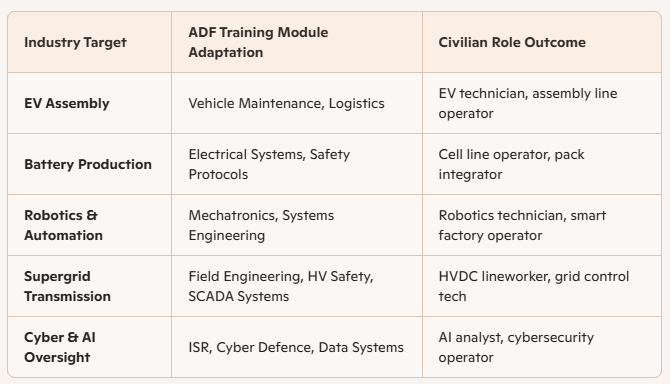
📍 Deployment Strategy
-
Use ADF Cadets + Reserves + Civilian Training Centres
-
Partner with TAFE, Defence Industry Schools, and RTOs
-
Deliver 12–18 month micro‑credential programs
-
Embed training into Defence EV rollout, battery hubs, and supergrid build zones
🚀 Outcome
-
Thousands of freed‑up APS staff retrained via ADF‑aligned pathways
-
Rapid workforce mobilisation for sovereign industries
-
Stronger Defence–Industry integration
-
Export‑ready smart factory and logistics teams
Education capability assessment and the unified future
Current system challenges
The traditional model follows a rigid sequence: School → Qualification → Employment. This siloed pathway has created acute systemic vulnerabilities across Australia:
- Weak workforce forecasting: Inability to anticipate critical sovereign industry needs.
- Poor industry links: Severe dislocation between classroom theory and practical vocational demand.
- Delayed curriculum changes: Protracted timelines to integrate emerging technological and trade competencies.
These bottlenecks lead to compounding skills shortages, underutilised graduate capacity, and falling productivity across our key economic sectors.
The Australians Unified future model
We replace lagging pipelines with an integrated national capability ecosystem: National Capability Forecast → Curriculum → Education Pathways → Workforce Outcomes → National Productivity Outcomes.
Key outcomes delivered:
- ✓ Better workforce planning: Real-time alignment with national infrastructure and industry priorities.
- ✓ Reduced skills shortages: Rapid micro-credentials and sovereign workforce pipelines.
- ✓ Stronger manufacturing: Dedicated apprenticeships and modernised TAFE delivery.
- ✓ Better AI capability: Comprehensive digital literacy and embedded STEM from early education.
The future-ready department of education blueprint
A national blueprint for equity, excellence, and lifelong learning
Australia requires an agile, unified education architecture capable of equipping every student, educator, and region for rapid global shifts. Our priority actions establish faster, responsive systems and self-reliant sovereign capability:
- Faster, more effective education systems: Implementing modern digital learning platforms, accelerated curriculum and assessment pathways, dynamic tertiary performance tools, and streamlined coordination across states and territories.
- Stronger sovereign education capability: Deploying specialist teaching and learning squads, national data modelling systems, robust oversight, and integrated workforce capability planning.
- A modern, resilient education workforce: Delivering teacher wellbeing initiatives, dedicated specialist development routes, and cutting-edge pedagogical tools.
Connected ecosystems and fair national access
Real reform demands connecting classrooms directly with public institutions, emerging industries, and diverse communities across Australia to ensure no learner is left behind:
- Better integration with government, industry, and community: Creating one national learning ecosystem through federated data-sharing platforms, collaborative partnerships with universities, TAFEs, and industry, and community intelligence systems.
- A more equitable, future-ready Australia: Broadening affordable early childhood access, safeguarding equity pipelines for vulnerable learners, supporting First Nations community-led schooling, and upholding open public transparency.
Strategic outcome: A resilient, highly skilled, and community-connected education network delivering long-term sovereign prosperity.
Condensed yearly costing model — Department of Education
A transparent baseline plus uplift investment framework designed to secure national capability, educator retention, and modernised learning infrastructure across Australia.
| Baseline funding (already provided) | Annual allocation |
|---|---|
| Core education operations | $1.20B |
| School & early childhood programs | $0.60B |
| Tertiary, skills & workforce development | $0.40B |
| Total baseline funding | $2.20B per year |
| Strategic phase | Uplift investment range |
|---|---|
| Phase 1 — Foundation (Years 1–2) | Annual: $1.40B – $1.90B | Total: $2.80B – $3.80B |
| Phase 2 — Acceleration (Years 2–4) | Annual: $1.90B – $2.50B | Total: $5.70B – $7.50B |
| Phase 3 — Expansion (Years 4–6) | Annual: $2.40B – $3.10B | Total: $4.80B – $6.20B |
| Phase 4 — Future-ready (Years 6–10) | Annual: $3.00B – $3.80B | Total: $12.00B – $15.20B |
| Total investment summary | Committed expenditure |
|---|---|
| 6-Year uplift total | $13.30B – $17.50B |
| 6-Year baseline total | $13.20B |
| Total 6-year investment | $26.50B – $30.70B |
| 10-Year uplift total | $24.50B – $32.70B |
| 10-Year baseline total | $22.00B |
| Total 10-year investment | $46.50B – $54.70B |
Education portfolio pathways
Explore Australians Unified’s education portfolio across national, state and local responsibilities, alongside the policy reforms that connect learning with workforce capability. Each pathway supports clearer accountability, equitable access and lifelong learning for Australians.

Australian education portfolio
Explore the national vision for early childhood, schools, higher education and skills: building equitable learning pathways, modern capability and a workforce ready for Australia’s future.

State education portfolio
See how state-level education leadership can strengthen school delivery, teacher support, regional access, vocational learning and partnerships that respond to Victorian communities.

Local education portfolio
Discover the local role in connecting families, schools, community services and employers, helping learners access practical support, inclusion and opportunities close to home.

Policy issues and amendments
Review education policy issues and proposed amendments through an accountability lens, with a focus on transparent funding, measurable outcomes and continuous improvement.
Education portfolio frequently asked questions
Find clear answers regarding our national education reform streams, sovereign workforce retraining programs, funding frameworks, and transition schools designed to secure Australia's future.