DEFENCE SCIENCE AND TECHNOLOGY GROUP (DSTG)
Australians Unified – Defence Portfolio
The Defence Science and Technology Group (DSTG) is Australia’s leading defence research organisation. It provides scientific advice, advanced research, and technological innovation to strengthen the Australian Defence Force (ADF) and national security.
DSTG works across cyber, space, autonomous systems, materials science, artificial intelligence, weapons development, and operational analysis — ensuring Australia remains technologically competitive in a rapidly evolving strategic environment.
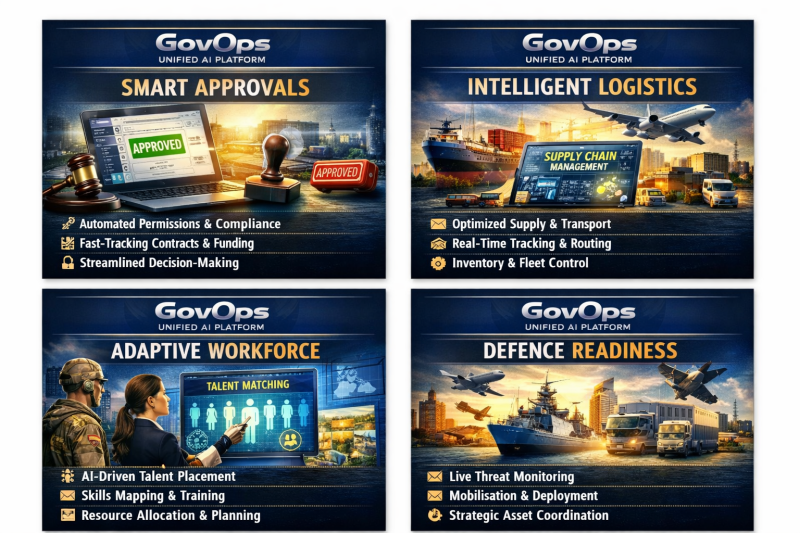
Gold standard enhancement framework
Positioning the Defence Science and Technology Group as Australia's premier sovereign research organisation to maintain a decisive strategic advantage and sovereign self-reliance.
Maturity assessment and potential
With a current maturity rating of 8.5/10, DSTG already demonstrates formidable scientific excellence. Under the Australians Unified framework, targeted reforms lift this potential to a flawless 10/10, eliminating procurement bottlenecks and bridging sovereign production gaps.
Expanded national authorities
DSTG will serve as Australia's central Defence Innovation Authority, Sovereign Technology Authority, and National Defence Research Integrator, driving cross-sector alignment across universities, private industry, and military commands.
Frontier capability centres
Establishing dedicated hubs including the Defence AI Centre, Defence Quantum Centre, and Defence Space Research Authority ensures Australian forces command regional superior technology across all emerging contested domains.
Technology acceleration and deployment
Operating as a fast-paced Defence Technology Accelerator, DSTG converts rapid prototypes into combat-ready frontline ADF capabilities while securing sovereign domestic microelectronics and supply chain resilience.

DSTG — ROLE & PURPOSE
DSTG exists to:
-
Deliver scientific and technical expertise to Defence
-
Develop advanced technologies for the ADF
-
Strengthen sovereign research and innovation capability
-
Support operations with modelling, simulation, and analysis
-
Partner with industry, academia, and international allies
DSTG is the bridge between science and warfighting capability.

DSTG — STRENGTHS
Core Strengths
-
World‑class scientific expertise across multiple disciplines
-
Strong partnerships with universities and global defence research agencies
-
Deep experience in operational analysis and modelling
-
High credibility within Defence decision‑making
-
Ability to innovate rapidly in crisis situations
Sovereign Strengths
-
Unique understanding of Australia’s strategic environment
-
Strong cyber and electronic warfare research capability
-
Growing space‑domain awareness expertise

DSTG — WEAKNESSES
These are high‑level, organisational weaknesses suitable for public‑facing material:
Structural Weaknesses
-
Slow research‑to‑capability transition due to complex procurement pathways
-
Heavy reliance on international partners for advanced technologies
-
Limited sovereign manufacturing capacity for high‑tech systems
-
Fragmented research programs across multiple sites
-
Difficulty scaling prototypes into deployable ADF capability
Workforce Weaknesses
-
Shortages in specialist STEM roles
-
High competition with private tech sector for talent
-
Long security‑clearance timelines slowing recruitment
-
Ageing workforce in niche scientific fields
Operational Weaknesses
-
Limited ability to rapidly respond to emerging threats
-
Legacy IT systems restricting data sharing and modelling
-
Insufficient integration with frontline ADF units during early research phases
Gold standard performance, reform priorities, and nation building
A comprehensive national blueprint integrating rigorous KPI tracking, transformative sovereign reform priorities, and whole-of-nation agency collaboration to secure Australia's defence technology leadership.
Gold standard KPI dashboard
Innovation:
• Research-to-capability transition time
• Prototype delivery speed
• Defence innovation index
• Technology readiness index
• Rapid experimentation success rate
Sovereign capability:
• Sovereign technology index
• Australian-owned intellectual property
• Defence manufacturing integration
• Supply chain sovereignty index
• Strategic dependency reduction index
Defence outcomes:
• Capability adoption rate
• Operational integration index
• ADF technology uptake
• Mission effectiveness contribution
• Force multiplier impact assessment
Workforce & industry:
• STEM recruitment growth & scientist retention
• Fast-tracked security clearance processing
• SME participation & university partnerships
• Commercialisation success & defence adoption
Australians unified reform priorities
Priority 1: National Defence Technology Command
• Integrates: AI, cyber, space, quantum, autonomous systems, and electronic warfare.
• Outcome: Faster technology deployment and a unified strategy.
Priority 2: Sovereign Technology Program
• Develop: Australian sensors, defence software, electronics capability, autonomous platforms, and space systems.
• Outcome: Decisive reduction in foreign dependency.
Priority 3: National Defence Research Network
• Connect: DSTG, universities, ANSTO, CSIRO, defence industry, and Defence Australia.
• Outcome: One unified defence innovation ecosystem.
Priority 4: Rapid Defence Innovation Pathway
• Accelerate: Research, rigorous testing, prototyping, operational field trials, and combat capability transition.
Role in nation building
Defence Australia & ANSTO:
• Future capability research, technology development, and strategic operational advantage.
• Nuclear systems, materials science, and radiation technologies.
Infrastructure Australia & Home Affairs:
• Smart infrastructure protection, transport resilience modelling, and emerging threat analysis.
• National resilience capability and sovereign security systems.
NEMA (Emergency Management):
• AI-supported disaster modelling, emergency prediction systems, and recovery technologies.
Universities & Industry:
• National STEM talent pipelines and research defence pathways.
• Advanced manufacturing commercialisation, supply expansion, and export growth.
Threats and opportunities analysis
A strategic evaluation of external pressures, internal capability limits, and sovereign expansion opportunities shaping the future of defence science in Australia.
External threats
Australia faces rapid technological advancement by potential adversaries alongside aggressive global competition for scientific talent. Critical research networks confront increasing cyber attacks, while supply-chain vulnerabilities threaten sovereign access to essential high-tech components.
Internal threats
Prolonged budget constraints restrict foundational long-term scientific research, compounded by slow capability transition pathways that diminish operational relevance. Heavy over-reliance on foreign technology for mission-critical systems exposes sovereign defence dependencies.
Strategic opportunities
Australia can expand sovereign defence technology development by accelerating research across AI, quantum, hypersonics, and autonomous platforms. Deepening partnerships with domestic universities and industry fosters a resilient, united national defence innovation ecosystem.
Operational opportunities
Modernising digital-twin, modelling, and simulation environments enables high-tempo prototyping and field experimentation. Embedding scientists with ADF units for real-world testing ensures rapid deployment of combat-ready space and cyber capabilities.
10-year strategic roadmap (2028–2037)
Transforming DSTG into Australia's sovereign defence innovation engine through a phased decadal plan connecting Defence, industry, universities, and national research institutions.
Phase 1 (2028–2030): foundations
Establishing a comprehensive national baseline across defence science. Key initiatives include the National Defence Science Dashboard, a Sovereign Capability Audit, national Workforce Strategy, Research Capability Mapping, and the Technology Readiness Framework to guarantee strong research foundations.
Phase 2 (2031–2033): growth
Rapidly scaling critical domestic technological capability. Priorities focus on rolling out the Defence AI Program, Defence Space Research Program, Defence Quantum Program, Sovereign Electronics Program, and expanding our collaborative University Innovation Network.
Phase 3 (2034–2035): integration
Accelerating field transition and ADF operational deployment. Delivers the Joint Science-Operations Centre, the defence innovation ecosystem, an Integrated Experimentation Network, autonomous systems capability, and the Rapid Operational Testing Framework to embed scientists directly into front-line commands.
Phase 4 (2036–2037): leadership
Achieving a world-class sovereign defence science capability. Solidifying Indo-Pacific defence innovation leadership, expanding defence export technology, unifying the National Defence Science Network, and operating an integrated whole-of-nation innovation system.
A national blueprint for sovereign defence science, innovation, and resilience
Faster innovation
Accelerating research, prototyping, and capability delivery
DSTG must move at the speed of modern conflict, transforming how research becomes sovereign capability. By establishing a Rapid Defence Innovation Pathway to cut approval times, creating mission-focused innovation cells for cyber, space, autonomous systems, and AI, expanding digital-twin simulation environments, and embedding scientists directly into frontline ADF units, Australia shifts from slow, linear development to agile, iterative innovation that stays decisively ahead of emerging threats.
Stronger sovereign capability
Reducing reliance on foreign technology and supply chains
A future-ready DSTG strengthens Australia's capacity to design, build, and sustain critical defence systems on home soil. Through expanding domestic manufacturing for sensors and electronics, engineering sovereign autonomous platforms across land, sea, air, and space, funding a national secure microelectronics initiative, and securing local industry supply chains, Australia ensures lasting technological independence and strategic resilience.
Workforce resilience, ADF integration, and regional edge
A modern, resilient defence science workforce
Building the talent pipeline for the next 50 years
DSTG’s future depends on attracting and retaining world-class scientific talent. To secure long-term capability, Australia must launch a National Defence Science Scholarship Program for STEM students, establish DSTG–University joint research labs in AI, quantum, hypersonics, and space, fast-track security clearances for critical positions, and introduce industry secondments. By fostering an inclusive workforce with transparent career progression, DSTG develops the skilled talent required to ensure national resilience.
Better integration with ADF operations
Science and warfighting working as one system
DSTG must be embedded directly in the operational environment, not isolated from frontline reality. Placing defence scientists inside Army, Navy, and Air Force units and expanding joint exercises enables emerging technologies to be validated under actual operational conditions. Establishing dedicated deployable operational analysis teams, alongside a Joint Science–Operations Centre powered by AI-driven modelling, ensures immediate decision support and makes ADF warfighting faster, more informed, and technologically superior.
A competitive edge in the Indo-Pacific
Positioning Australia as a regional leader in defence science
The Indo-Pacific is becoming the world’s most strategically contested region. A future-ready DSTG ensures Australia commands an enduring competitive edge through proactive technological leadership. By establishing regional partnerships in cyber security, space systems, and autonomous platforms, DSTG deepens collaborative research with trusted regional allies while countering emerging strategic threats.
Key strategic priorities include developing Indo-Pacific-tailored research initiatives, expanding leadership within multilateral science and technology forums, and establishing a dedicated regional centre of excellence for defence innovation. These coordinated initiatives ensure Australia remains a trusted, technologically advanced defence leader across our immediate theatre and global alliances.
The future-ready DSTG — what Australia gains
A modernized Defence Science and Technology Group delivers vital strategic dividends for the nation: a faster, more agile innovation ecosystem; sovereign control over critical technologies; a world-class defence science workforce; seamless integration between science and frontline ADF operations; and an enduring strategic advantage in a contested region.
This is the DSTG Australia needs for the next generation — sovereign, resilient, innovative, and mission-ready.
Budget, ownership, and risk framework (2028–2037)
A targeted $40.5 billion 10-year investment framework establishing clear institutional ownership, strategic risk mitigation, and unified nation-building accountability to secure Australia's sovereign defence science edge.
$40.5B strategic investment framework
A fully budgeted decadal program allocating $18B to core research and development, $5B to space technologies, $4B each to AI and autonomy and cyber/electronic warfare, $3B each to sovereign microelectronics and quantum technologies, $2B to advanced manufacturing research, and $1.5B to university research partnerships.
Institutional ownership and governance
DSTG leads national defence science strategy, innovation, and capability experimentation. Key joint owners include the Department of Defence for operational integration, CASG for acquisition transition, ASD for cyber and electronic warfare, ANSTO for nuclear and advanced materials, and CSIRO for commercialisation.
Strategic risk register and mitigations
Directly confronting critical risks: foreign technology dependencies are resolved via the Sovereign Technology Program; workforce shortages are mitigated through the Defence STEM Pipeline and apprenticeships; commercialisation gaps are bridged by rapid prototyping offices; and strategic surprises are countered by the Emerging Threat Analysis Centre.
Whole-of-nation building participation
Mobilising cross-sector assets: Education Australia delivers 100,000 new STEM graduates by 2037, Industry Australia drives a 50% increase in sovereign production, Infrastructure Australia builds national innovation corridors, while state and local governments establish defence hubs and regional supplier networks across every jurisdiction.
Frequently asked questions
Common questions regarding the Defence Science and Technology Group (DSTG), sovereign research priorities, and ADF capability enhancements under the Australians Unified blueprint.