🛡 Defence Australia
Gold Standard Portfolio Overview
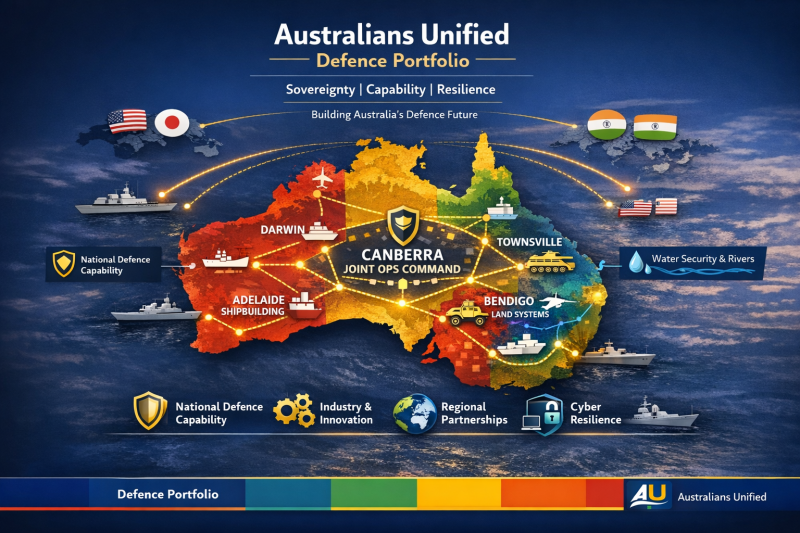
Australians Unified | National Defence, Sovereignty & Strategic Readiness
Portfolio: Department of Defence
Primary Pillar: 🛡 Sovereignty
Supporting Pillars: 🚀 Future Australia • 💰 Prosperity • ⚖ Accountability • 🤝 Unity
📌 Executive Summary
✅ Defend Australia's sovereignty
✅ Protect Australians and national interests
✅ Deter conflict through capability and readiness
✅ Support regional stability
✅ Build sovereign defence industries
✅ Strengthen cyber and space capabilities
✅ Protect critical infrastructure
✅ Support disaster relief and humanitarian operations
✅ Develop future defence technologies
National mission: Protect and strengthen Australia
Protect Australia
Safeguarding our Commonwealth begins with an unyielding commitment to territorial integrity and robust national security across all fronts. Our strategic focus prioritises complete air, space, and maritime domain awareness alongside proactive cyber defence to deter international coercion. By establishing effective strategic deterrence and sovereign operational control, we protect Australian lives, vital sea lanes, and critical infrastructure against emerging global threats.
Strengthen Australia
True security requires robust sovereign self-reliance and homegrown industrial endurance. We focus on building sovereign manufacturing capacity, accelerating sovereign defence technologies, and safeguarding strategic industries. Through targeted skills development, technical workforce retention, cutting-edge defence innovation, and unified civil-defence partnerships, Australia strengthens national resilience to withstand systemic supply shocks and maintain enduring preparedness.


Australian Defence Force (ADF)
AUSTRALIAN DEFENCE FORCE
Protecting Australia at Home & Abroad
What They Do
-
Land, air, maritime & joint operations
-
Rapid response & national defence readiness
-
Humanitarian & disaster relief
-
International peacekeeping missions
Why It Matters
-
Safeguards national sovereignty
-
Responds to crises and emergencies
-
Strengthens regional stability
-
Supports global security partnerships
Key Outputs
-
Operational deployments
-
Readiness reporting
-
Humanitarian missions
-
Defence capability delivery

Australian Signals Directorate (ASD)
AUSTRALIAN SIGNALS DIRECTORATE
Cyber Defence, Intelligence & Digital Security
What They Do
-
Cyber threat detection & defence
-
Signals intelligence (SIGINT)
-
Offensive cyber operations
-
Critical infrastructure protection
Why It Matters
-
Shields Australia from cyber attacks
-
Protects government & industry networks
-
Strengthens national digital resilience
-
Supports defence & intelligence operations
Key Outputs
-
Cyber threat intelligence
-
National cyber defence operations
-
SIGINT reporting
-
Infrastructure security programs

Capability Acquisition & Sustainment Group (CASG)
CAPABILITY ACQUISITION & SUSTAINMENT GROUP
Delivering & Maintaining Australia’s Defence Assets
What They Do
-
Procure ships, aircraft, vehicles & systems
-
Sustain defence platforms
-
Manage industry partnerships
-
Oversee lifecycle planning
Why It Matters
-
Ensures ADF capability is modern & reliable
-
Strengthens sovereign manufacturing
-
Reduces foreign dependency
-
Supports long‑term defence readiness
Key Outputs
-
Procurement programs
-
Sustainment schedules
-
Industry contracts
-
Capability lifecycle plans
Joint Operations Command (JOC)
JOINT OPERATIONS COMMAND
Coordinating Australia’s Military Operations
What They Do
-
Command & control of ADF operations
-
Strategic logistics & deployment
-
International defence cooperation
-
Multi‑domain operational planning
Why It Matters
-
Ensures coordinated national defence
-
Strengthens global partnerships
-
Enables rapid response
-
Supports regional stability
Key Outputs
-
Operational plans
-
Deployment coordination
-
Joint training programs
-
Strategic logistics frameworks

WEAKNESSES BY CATEGORY — AUSTRALIAN DEFENCE FORCE

Australian Defence Force Headquarters (ADFHQ)
Weaknesses
-
Complex decision‑making layers slow down responsiveness during fast‑moving crises.
-
Heavy administrative burden reduces agility and operational focus.
-
Coordination challenges between strategic leadership and service‑level execution.
-
Resource competition across services can create internal bottlenecks.
-
Dependence on legacy systems limits real‑time data integration and situational awareness.

Joint Capabilities Group (JCG)
Weaknesses
-
High demand for specialised skills (cyber, intelligence, space) outpaces recruitment and training capacity.
-
Fragmented capability development across domains can lead to duplication or gaps.
-
Reliance on external contractors for critical technical functions reduces sovereign control.
-
Rapidly evolving technology makes it difficult to maintain up‑to‑date systems.
-
Interoperability issues between services and partner nations require constant alignment.

Joint Operations Command (JOC)
Weaknesses
-
Operational tempo pressures strain personnel and resources during prolonged missions.
-
Logistics vulnerabilities in supply chains, especially for remote or maritime operations.
-
Limited surge capacity for simultaneous domestic and international operations.
-
Dependence on ageing infrastructure at key operational hubs.
-
Complex multinational coordination can slow decision cycles during coalition operations.
Defence Australia performance targets and strategic timeline
Australians Unified Defence Capability Roadmap, 2028–2037. Strategic objective: build a sovereign, technologically advanced and highly prepared Defence Force; strengthen Australia’s defence industry; increase national self-reliance; improve military readiness; expand cyber and space capability; and reduce critical supply-chain dependence.
Gold standard KPI dashboard — baseline 2028 / target 2032 / target 2037: Defence Readiness Index 100 / 140 / 220; Sovereign Capability Index 100 / 150 / 250; Defence Manufacturing Index 100 / 135 / 210; Cyber Capability Index 100 / 145 / 240; Space Capability Index 100 / 140 / 220; Strategic Mobility Index 100 / 140 / 210; Supply Chain Security Index 100 / 135 / 220; Defence Workforce Index 100 / 140 / 210; Research and Innovation Index 100 / 145 / 220.
Australia’s Defence Portfolio should be measured not only by military spending, but by readiness, sovereign capability, industrial strength, workforce development, technological leadership and the ability to defend Australia’s national interests independently when required.

Phase 1: foundation and readiness
2028–2030 targets
- 95% operational force readiness; complete the national defence capability audit and critical capability-gap assessment.
- Increase defence workforce recruitment by 15% and cyber workforce capability by 20%.
- Lift sovereign manufacturing participation by 10% and Australian SME defence contracts by 20%.
- Establish a National Defence Industry Register and operational National Sovereign Supply Chain Dashboard.
National outcomes: Defence Readiness Index 120; Sovereignty Capability Index 115; Defence Workforce Index 120.
Success measure: assess capability, build foundations, establish dashboards and identify gaps.

Phase 2: capability expansion
2031–2033 targets
- Increase cyber defence capability by 25%, deployable force capacity by 20%, and strategic logistics capability by 30%.
- Implement 100% real-time readiness reporting and an Integrated Defence Operations Dashboard.
- Increase Australian defence manufacturing by 35%, reduce overseas supply dependency by 25%, establish guided-weapons production, and expand naval and aerospace manufacturing.
National outcomes: Defence Readiness Index 140; Defence Manufacturing Index 135; Strategic Mobility Index 140; Supply Chain Security Index 135.
By 2032: 25,000 additional defence industry jobs, 20% more Australian manufacturing participation, 25% less critical foreign-supply exposure, and $5 billion more sovereign defence industry activity. Success measure: expand capability, strengthen industry, reduce dependencies and grow the workforce.

Phase 3: sovereign capability growth
2034–2035 targets
- Increase cyber operations capacity by 50%, space-based capability by 40%, and joint-force readiness by 30%.
- Achieve 90% sovereign sustainment capability for critical assets and make the strategic reserve framework fully operational.
- Increase sovereign defence production by 50%; achieve 75% Australian support capability for key defence assets.
- Build national advanced weapons manufacturing and national autonomous systems capability.
National outcomes: Sovereignty Capability Index 180; Defence Technology Index 170; Strategic Readiness Index 175; Defence Industry Capability Index 180.

Phase 4: strategic excellence
2036–2037 targets
- Achieve world-class readiness standards, 95% sovereign sustainment of critical defence systems, and full national strategic-warning capability.
- Deploy an AI-enhanced operational-readiness platform and fully integrate the National Defence Operations Centre.
- Reduce critical defence import dependency by 60%; establish an Australian-led advanced defence manufacturing ecosystem, global export capability in priority sectors, and a strategic defence innovation network.
National outcomes: Defence Readiness Index 220; Sovereignty Index 250; Defence Innovation Index 220; Defence Manufacturing Index 210; National Resilience Index 220.
By 2037: 50,000 additional high-skill defence jobs, 50% higher sovereign manufacturing participation, 60% lower critical import dependency, $15 billion more strategic industry output and top-tier Indo-Pacific defence innovation capability. Success measure: sovereign defence capability, strategic self-reliance, advanced manufacturing leadership, world-class readiness and strong national security.
Implementation roadmap
A phased rollout designed to strengthen sovereign resilience, legal governance, and regional capabilities without replacing civilian contractors. Built on clear safeguards, disciplined execution, and the enduring AISP promise of partnership.
Phase 1 — Policy & governance
Establish the AISP governance board to maintain strict whole-of-nation oversight. Define explicit legal boundaries, DACC/DACA approval pathways, and create the national infrastructure priority list to ensure non-commercial transparency.
Phase 2 — Capability mapping
Identify ADF engineering and logistics units suited for civil support roles. Map critical civilian industry gaps and develop joint civilian-military training programs alongside return-to-work skill pathways.
Phase 3 — Pilot projects
Execute targeted demonstrator trials across three strategic environments: one northern region, one remote Indigenous community, and one disaster-prone territory to test joint delivery models and community integration.
Phase 4 — National rollout & the AISP promise
Deploy the annual infrastructure support plan, integrated Defence-civil exercises, and continuous evaluation. This fulfills our promise: a stronger, safer, and more resilient Australia built through genuine partnership, not competition.
ADF infrastructure support partnership
A lawful, strategic and community-focused framework for integrating Australian Defence Force engineering and logistics capability into national infrastructure planning. The proposed ADF Infrastructure Support Partnership (AISP) strengthens resilience, sovereign capability, energy and water security, and whole-of-nation preparedness—while civilian industry remains the primary builder and delivery workforce.

Strategic infrastructure support
Planned, long-term and non-competitive. ADF engineers provide technical advice, resilience planning, environmental assessment and limited support for nationally significant assets: northern bases, dual-use airfields, fuel and logistics hubs, remote communications and radar sites, resilient transport corridors, and critical energy and water grids. Civilian firms lead construction and delivery.

Emergency and disaster response
Rapid, lawful and high-impact. When civilian capacity is overwhelmed, ADF engineers can support government-led recovery by restoring washed-out bridges and access roads, repairing cyclone- or fire-affected airfields, establishing temporary shelters or field hospitals, and reconnecting power and communications under Defence Assistance to the Civil Community arrangements.

Remote community partnerships
Partnership-based and culturally respectful. In remote locations where industry capacity is limited or unavailable, ADF engineering support can assist government and community priorities including safe water infrastructure, access roads, health and community facilities, emergency airstrips and environmental remediation. This approach supports Closing the Gap objectives and enduring regional relationships.

Safeguards, skills and accountability
Partnership, never market displacement. ADF involvement must be government-requested, non-commercial and unable to tender for civilian projects. Industry, unions, local government and communities are consulted. Joint exercises, capability mapping and return-to-work education pathways build a skilled civilian workforce while giving Defence engineers practical readiness experience.
Defence portfolio questions and answers
Find clear answers regarding Australia's defence strategy, sovereign manufacturing targets, force readiness, and collaborative civil infrastructure partnerships.