🏗 Defence Estate & Infrastructure Australia (DEIA)
National Defence Infrastructure • Strategic Estates • Sovereign Construction • Future Ready Australia
Current Government Equivalent: Security and Estate Group (formerly Defence Estate & Infrastructure Group) within the Department of Defence. It develops, sustains and protects the Defence estate, manages major infrastructure, supports base services and oversees one of the Commonwealth's largest property portfolios. [defence.gov.au], [directory.gov.au]
Primary Pillar: 🛡 Sovereignty
Supporting Pillars: 🚀 Future Australia • 💰 Prosperity • ⚖ Accountability • 🤝 Unity
📌 Executive Summary
Defence infrastructure is not simply about buildings.
It is the physical backbone of national sovereignty.
Australians Unified positions Defence Estate & Infrastructure as the organisation responsible for building and maintaining the strategic infrastructure that enables:
✅ Defence readiness
✅ Northern Australia development
✅ National logistics capability
✅ Strategic mobility
✅ Energy security
✅ Climate resilience
✅ Defence industry growth
✅ Community resilience
✅ Whole-of-nation preparedness
🎯 National Mission
Build Australia's Strategic Defence Infrastructure
✅ Defence Bases
✅ Ports
✅ Airfields
✅ Training Areas
✅ Logistics Networks
✅ Communications Infrastructure
✅ Fuel Storage Systems
✅ Defence Housing
✅ Strategic Precincts
Support Future Ready Australia
✅ Smart Infrastructure
✅ Renewable Energy Integration
✅ Autonomous Logistics Infrastructure
✅ Climate Resilient Facilities
✅ Digital Estate Management
✅ Northern Australia Capability Expansion
Defence estate and infrastructure: a whole-of-nation model
Australians Unified connects current Defence estate responsibilities with a nation-building vision across federal, state and local partners. The model strengthens military mobility, regional development, sovereign industry, emergency readiness and community resilience.

Current government functions
The current Security and Estate Group plans and delivers Defence infrastructure; manages Defence bases and facilities; maintains more than 3.8 million hectares of land; and supports more than 70 major Defence bases.
Its responsibilities include training ranges and Defence properties, base services and estate management, plus environmental stewardship and resilience initiatives.

Nation-building infrastructure
Australians Unified sees the Defence Estate as national infrastructure that drives regional development, Defence industry growth, workforce development, strategic resilience, emergency capability, community infrastructure and national preparedness.
In partnership with Infrastructure Australia, Defence supports northern Australia infrastructure, strategic road corridors, major ports, airfield expansion, fuel security, logistics hubs and intermodal freight networks. This delivers stronger military mobility, economic productivity and disaster response.
Defence infrastructure also enables shipbuilding, guided weapons manufacturing, advanced manufacturing, aerospace, Defence technology precincts and strategic industrial zones—supporting sovereign capability, exports and regional jobs. It underpins disaster response, emergency logistics, community recovery, humanitarian assistance and emergency mobilisation for faster deployment and greater resilience.

State strategic development
The proposed Defence Infrastructure & Strategic Development Authority (DISDA) would coordinate state Defence infrastructure planning, strategic precinct development, Defence industry zones, regional development, utility integration, Defence land coordination and workforce infrastructure.
State inputs include: Victoria’s Development Victoria, Defence Victoria, Major Transport Infrastructure Authority, Infrastructure Victoria and Regional Development Victoria; South Australia’s Defence SA, AUKUS infrastructure programs, Osborne Precinct development and regional development agencies; Queensland’s Defence Queensland, northern infrastructure programs and regional growth precincts; and Western Australia’s Defence West, maritime infrastructure planning and strategic industrial development.

Local infrastructure partnerships
The Defence Infrastructure Partnership Network (DIPN) brings together local government, Defence communities, utilities, regional development agencies, industry groups, TAFEs and community organisations.
Local partners help coordinate land-use planning, Defence community integration, roads and access, housing, workforce development, emergency preparedness and precinct planning—making Defence investment work for communities as well as national security.
Major Australians Unified reform projects
Australians Unified’s national defence infrastructure dashboard applies a strategic planning model to monitor base readiness, infrastructure condition, project delivery, climate impacts, asset utilisation and regional development outcomes.
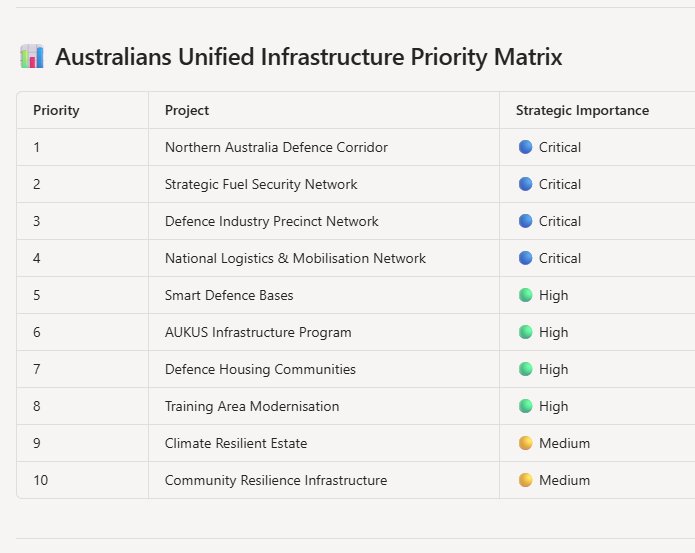
Strategic investment framework, 2028–2037: $80 billion total. Base modernisation program: $20B; Northern Australia infrastructure: $15B; training area modernisation: $10B; national logistics infrastructure: $10B; smart bases program: $8B; strategic fuel security program: $6B; defence industry precincts: $6B; and climate resilience program: $5B.
Gold standard KPI dashboard
Infrastructure: Base Readiness Index, Infrastructure Reliability Index, Asset Condition Index, Infrastructure Delivery Performance and Estate Modernisation Index.
Sovereignty: Strategic Mobility Index, Fuel Security Index, Sovereign Infrastructure Capability, Northern Australia Readiness Index and Logistics Resilience Index.
Industry: Australian Content %, Local Procurement %, SME Participation, Defence Precinct Growth and Regional Industry Investment.
Sustainability: Renewable Energy Usage, Water Security Index, Climate Resilience Score, Emissions Reduction Performance and Environmental Stewardship Index.
Governance and accountability: Defence Australia leads the National Estate Strategy, infrastructure investment, strategic prioritisation and national capability oversight. State DISDA coordinates state delivery, precinct development, regional planning and infrastructure partnerships. Local DIPN supports community integration, planning, regional workforce coordination and infrastructure readiness.

Northern Australia defence corridor
Develop: Darwin, Townsville, Cairns, Katherine, Tindal and Pilbara connections. This integrated northern corridor links bases, airfields, ports, logistics and regional infrastructure to strengthen deployment capacity.
Outcome: strategic northern capability, regional development and national resilience.

Strategic fuel security program
Build: national fuel reserves, distribution infrastructure, strategic storage facilities and emergency supply networks. The program secures the fuel systems needed to sustain Defence mobility and whole-of-nation emergency operations.
Outcome: sovereign logistics capability.

Defence smart bases program
Deliver: renewable energy, smart grid technology, water resilience, AI estate management and autonomous logistics systems across the Defence estate.
Outcome: reduced operating costs and higher resilience, supported by measurable renewable energy, water security, emissions reduction and environmental stewardship performance.

National training area modernisation
Upgrade: Army training areas, air combat training facilities, amphibious facilities, joint operations capability and allied training infrastructure.
Outcome: improved readiness and enhanced allied interoperability, with infrastructure delivery aligned to national capability priorities and regional workforce readiness.

OUR STRENGTHS
Infrastructure Strengths
-
One of Australia’s largest and most diverse property portfolios
-
Strong project management and engineering capability
-
Deep experience delivering complex, multi‑year infrastructure programs
-
Strategic presence across all states and territories
-
Strong relationships with industry and government partners
Sovereign Strengths
-
Nationally coordinated Defence infrastructure planning
-
Long‑term investment in sovereign construction capability
-
Stewardship of critical national assets

OUR WEAKNESSES
Structural Weaknesses
-
Ageing infrastructure across many bases
-
Maintenance backlogs in high‑demand regions
-
Slow delivery cycles for major projects
-
Fragmented digital systems for estate management
-
Limited surge capacity for rapid infrastructure needs
Operational Weaknesses
-
Climate impacts on bases and training areas
-
Rising construction and materials costs
-
Limited accommodation and facilities in remote regions
-
Inconsistent infrastructure standards across states

OUR THREATS
External Threats
-
Climate‑driven damage to infrastructure
-
Supply‑chain disruptions for construction materials
-
Workforce shortages in engineering and trades
-
Rising costs for major capital works
Internal Threats
-
Ageing estate requiring significant reinvestment
-
Slow project approvals
-
Inconsistent maintenance standards
-
Limited data integration across systems
OUR OPPORTUNITIES
Strategic Opportunities
-
Modernise bases to support next‑generation Defence capability
-
Expand northern Australia infrastructure
-
Strengthen sovereign construction and engineering capability
-
Integrate renewable energy and smart‑base technologies
-
Improve environmental sustainability and land stewardship
Operational Opportunities
-
Upgrade training areas for joint and allied exercises
-
Improve accommodation, messes, and community facilities
-
Expand digital estate management systems
-
Strengthen partnerships with local councils and industry
10-year strategic roadmap (2028–2037)
Australians Unified sets out a clear, four-phase plan to modernise Australia's Defence estate, expand critical infrastructure across the north, and secure sovereign self-reliance through coordinated national and state delivery.
Phase 1 (2028–2030): Foundation and baseline
Phase 1 establishes the national defence estate audit, delivers a transparent infrastructure dashboard, institutes state affiliates, assesses strategic fuel security, and sets rigorous condition baselines across all Australian bases.
Phase 2 (2031–2033): Acceleration and precinct expansion
Phase 2 accelerates major base modernisation, activates the smart base digital and clean-energy rollout, expands dedicated defence precincts, and unlocks strategic logistics corridors throughout northern Australia.
Phase 3 (2034–2035): Sovereign logistics and resilience
Phase 3 establishes our sovereign logistics network, deploys the integrated infrastructure platform, completes comprehensive climate resilience upgrades, and embeds regional defence city operating models.
Phase 4 (2036–2037): Integrated national mobilization
Phase 4 completes the fully integrated defence estate system, links the national strategic infrastructure network with industry ecosystems, and delivers a robust, whole-of-nation mobilisation capability for Australia's future.
ADF-enabled 10-year infrastructure mobilisation model
Australians Unified coordinates defence engineering capability, civilian delivery, and strategic workforce reallocation to deliver sovereign national resilience and critical clean-energy transmission infrastructure.
1. Business operations merge
Purpose: Free up workforce capacity and capital through systematic federal agency consolidation.
Cost: $8.6B | Savings: $24B–$31B
Staff freed: ~38,000 personnel.
ADF role: Coordinate transition logistics, deploy unified digital systems, and lead retraining frameworks.
2. National energy super-grid
Purpose: Construct a secure, sovereign, renewable-ready transmission spine across Australia.
Preferred build: Civilian + ADF delivery at $180B.
Projected revenue: $280B–$360B | Staff required: ~22,000.
ADF role: Deploy engineering battalions, remote logistics, and hardened communications.
3. Renewable super-grid (AU + NZ + Pacific)
Purpose: Expand Australia’s energy backbone across the Indo-Pacific region.
Investment: $372B–$446B | Revenue: $486B–$653B.
Workforce needed: ~60,000 personnel.
ADF role: Regional deployment, NZDF joint coordination, infrastructure protection, and disaster readiness.
4. Strategic workforce reallocation
Purpose: Close the national infrastructure talent gap through direct redeployment and education.
Freed from merge: ~38,000 | Total needed: ~82,000 (net gap: ~44,000).
ADF fill: 20,000 technical specialists, engineers, and logisticians.
Education & regional programs: 24,000 via vocational mobilization pipelines.
BETTER INTEGRATION WITH ADF OPERATIONS
Infrastructure aligned with Defence capability needs
Key Actions
-
Northern Australia expansion
-
Joint and allied training infrastructure
-
Integrated planning with ADF capability managers
-
Data‑driven estate forecasting
Outcome: Stronger alignment with operational readiness.
5. A COMPETITIVE EDGE IN NATIONAL RESILIENCE
Infrastructure that supports Defence and the nation
Key Actions
-
Renewable energy and sustainability programs
-
Environmental stewardship and land care
-
Community partnerships around bases
-
Disaster‑resilient infrastructure
Outcome: A Defence estate that strengthens national resilience.

THE FUTURE‑READY DEFENCE ESTATE & INFRASTRUCTURE GROUP
A national blueprint for modern, sustainable, mission‑ready Defence infrastructure
1. FASTER INFRASTRUCTURE DELIVERY
Accelerating upgrades, repairs, and new builds
Key Actions
-
National estate audit and prioritisation
-
Rapid‑delivery infrastructure programs
-
Modernised maintenance systems
-
Faster approvals and project pathways
Outcome: A safer, more responsive Defence estate.
2. STRONGER SOVEREIGN INFRASTRUCTURE CAPABILITY
Building Australian bases with Australian industry
Key Actions
-
Defence‑led construction precincts
-
Local industry partnerships
-
Sovereign supply chains for materials
-
National Defence Infrastructure Pipeline
Outcome: A more self‑reliant, resilient Defence infrastructure system.
3. A MODERN, RESILIENT DEFENCE ESTATE
Upgrading bases for the next generation of Defence capability
Key Actions
-
Modern accommodation and mess facilities
-
Upgraded airfields, ports, and training areas
-
Smart‑base technologies
-
Climate‑resilient design standards
Outcome: A modern, mission‑ready Defence estate.
DEFENCE PORTFOLIO — YEARLY COSTING MODEL
Aligned to the Master Strategic Roadmap (Foundation → Acceleration → Expansion → Future‑Ready)
PHASE 1 — FOUNDATION (Years 1–2)
Stabilise & Strengthen Core Systems
Estimated Annual Cost: $4.2B – $5.1B per year
Breakdown:
-
Estate audits, safety upgrades: $1.2B
-
Housing repairs & temporary accommodation: $0.8B
-
Digital modernisation & data systems: $0.6B
-
Workforce & family support uplift: $0.4B
-
Rapid innovation pathways (DSTG, ASD): $1.2B
2‑Year Total: $8.4B – $10.2B
PHASE 2 — ACCELERATION (Years 2–4)
Modernise & Expand Capability
Estimated Annual Cost: $6.5B – $8.1B per year
Breakdown:
-
Base modernisation & training area upgrades: $2.4B
-
Cyber & intelligence expansion (ASD): $1.1B
-
Health & housing modernisation: $1.2B
-
Industry partnerships & sovereign supply chains: $1.0B
-
Youth development expansion (ADF Cadets): $0.3B
-
Digital Defence ecosystem rollout: $0.5B
3‑Year Total: $19.5B – $24.3B
PHASE 3 — EXPANSION (Years 4–6)
Grow Sovereign Capability
Estimated Annual Cost: $8.8B – $10.4B per year
Breakdown:
-
Sovereign manufacturing & supply chains: $2.0B
-
Northern Australia expansion: $2.5B
-
National science & technology uplift (DSTG): $1.4B
-
Defence housing precincts: $1.2B
-
Community & family support expansion: $0.6B
-
Regional & allied partnerships: $1.1B
2‑Year Total: $17.6B – $20.8B
PHASE 4 — FUTURE‑READY (Years 6–10)
A Modern, Resilient Defence System
Estimated Annual Cost: $9.5B – $12.2B per year
Breakdown:
-
Smart‑base technologies & automation: $2.2B
-
Climate‑resilient infrastructure: $2.0B
-
Fully modernised Defence estate: $3.0B
-
Integrated digital Defence ecosystem: $1.0B
-
Continuous capability innovation: $1.3B
4‑Year Total: $38B – $48.8B
TOTAL COST — 6‑YEAR MODEL
(Foundation → Acceleration → Expansion)
$45.5B – $55.3B
This represents a moderate uplift consistent with Defence transformation programs.
TOTAL COST — 10‑YEAR MODEL
(Full Future‑Ready Defence Portfolio)
$84.0B – $104.1B
This is consistent with long‑term Defence estate, capability, and workforce modernisation programs.
Australians Unified Infrastructure Vision 2037
By 2037, Defence Estate & Infrastructure becomes a national nation-building platform that helps deliver:
✅ Strategic ports and airfields
✅ Sovereign fuel security
✅ Defence manufacturing precincts
✅ National logistics corridors
✅ Climate-resilient infrastructure
✅ Defence housing communities
✅ Emergency response capability
✅ Regional economic growth
✅ Workforce development precincts
✅ Whole-of-nation mobilisation readiness
Infrastructure is no longer viewed solely as Defence construction. It becomes a strategic sovereign capability system supporting Defence readiness, industry development, workforce growth, emergency resilience, regional prosperity and Australia's long-term national self-reliance. 🇦🇺🏗️🛡️🚢✈️🏭📊🏘️
Defence Estate & Infrastructure FAQ
Find answers to common questions regarding Australia's defence estate modernisation, sovereign construction programs, northern base development, and the 10-year infrastructure roadmap.